The cheapest way to move your vehicle might actually be the most expensive mistake you make this year. It’s natural to focus on the bottom line when you’re planning a long distance move, especially when you’re trying to decipher complex quotes and 2026 fuel surcharges. Most owners feel a bit of anxiety regarding road debris or weather damage, and that’s a valid concern for any valuable asset. Understanding the nuances of open vs enclosed car transport cost is about more than just comparing two numbers on a screen; it’s about weighing the physical risks of the road against your specific budget requirements.
We recognize that opaque pricing models can make this decision feel overwhelming. This guide is designed to provide a clear framework for calculating the return on investment for different levels of protection. You’ll learn exactly what drives these rates in the current market and how to identify which service aligns with your vehicle’s value. Our goal is to provide the clarity you need to choose a carrier with total confidence, ensuring your vehicle arrives safely while keeping your logistical costs manageable.
Key Takeaways
- Understand how 2026 logistical shifts, such as diesel price stability and labor trends, create a dynamic pricing environment for vehicle shipping.
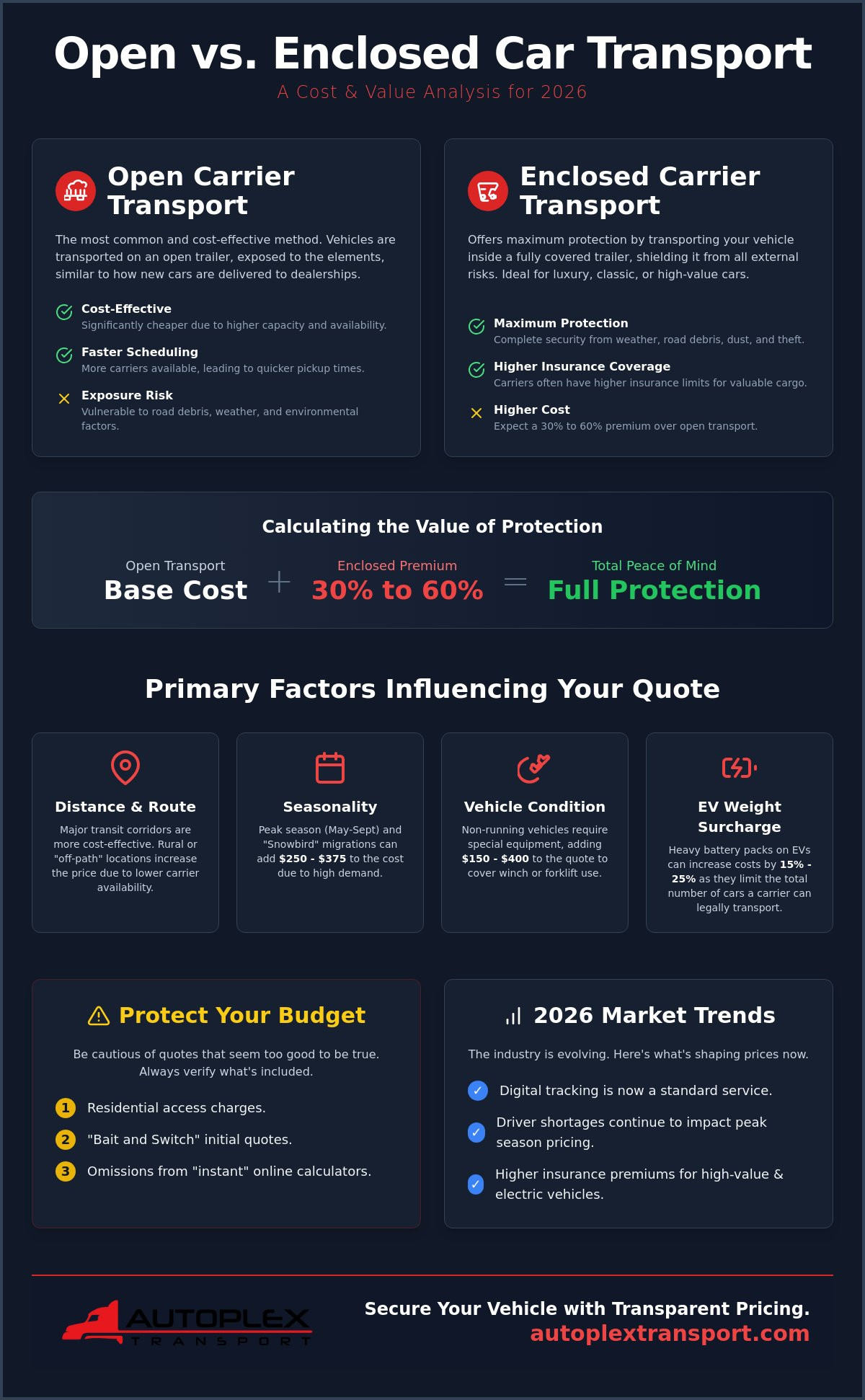
- Evaluate the 30% to 60% premium associated with the open vs enclosed car transport cost to determine if your vehicle requires specialized equipment or standard transport.
- Learn why shipping along major transit corridors is more cost-effective than rural pickups due to carrier availability and route efficiency.
- Protect your budget by identifying common hidden fees, including residential access charges and deceptive “Bait and Switch” initial quotes.
- Gain a framework for calculating the ROI of vehicle protection to ensure you are paying for the security you need without overspending on unnecessary extras.
Decoding the Variables of Car Transport Cost in 2026
Car transport cost isn’t a fixed menu price. It’s a dynamic calculation that shifts based on mileage, the specific equipment required, and the current capacity of the national carrier network. When you evaluate the open vs enclosed car transport cost, you’re seeing the intersection of logistical efficiency and specialized asset protection. In 2026, these rates are heavily influenced by a stabilized diesel market and significant shifts in the labor pool. While fuel prices have found a steady rhythm, the cost of specialized labor remains a primary driver for quote variations across all vehicle classes.
Many customers are surprised to find that short-haul interstate shipping often carries a higher cost per mile than cross-country routes. This happens because the fixed costs of loading, securing, and unloading a vehicle remain the same regardless of the distance traveled. A 300-mile trip requires the same amount of administrative work and equipment preparation as a 2,000-mile journey. This reality naturally pushes the per-mile rate higher for shorter distances, making long-haul routes appear more cost-effective on a unit basis.
The Anatomy of a Vehicle Shipping Quote
A professional quote reflects a complex balance of operational expenses. Fuel typically accounts for a significant portion of the total cost, followed closely by carrier maintenance and high-limit cargo insurance. It’s helpful to distinguish between broker coordination fees, which cover the logistics of finding a verified carrier, and the carrier’s own operational costs. You should be cautious with “instant” online calculators. These tools often fail to account for current market capacity or specific logistical surcharges like residential access fees, leading to unexpected price adjustments later in the process.
Market Trends Shaping 2026 Pricing
The industry has moved toward higher transparency, making digital tracking a standard expectation rather than a luxury. This real-time visibility adds value but also requires carriers to invest in sophisticated GPS and communication hardware. Nationwide driver shortages continue to impact peak season pricing, especially from May through September when demand for trailer space is at its highest. Additionally, carrier insurance premiums have seen a steady increase in 2026 as providers adjust to the rising market value of modern electric and luxury vehicles. This shift ensures that high-value assets remain fully protected during transit, even as vehicle replacement costs rise.
Primary Factors Influencing Your Shipping Estimates
Calculating your specific open vs enclosed car transport cost requires a look at several variables that go beyond just the distance between point A and point B. While mileage is the foundation of any quote, the efficiency of the route plays a massive role in the final price. Carriers prefer popular transit corridors, such as the routes connecting major metropolitan hubs, because they can easily fill their trailers. If your vehicle is located in a rural or “off-path” area, you’ll likely see a higher estimate to account for the extra time and fuel the driver spends reaching your location.
The physical condition of your vehicle also dictates the level of labor required for a successful load. Shipping a non-running vehicle typically adds $150 to $400 to the total cost. This isn’t an arbitrary fee; it covers the specialized use of winches or forklifts and the technical labor involved in safely maneuvering an inoperable car onto a trailer. If you are moving a standard running vehicle between major cities, you can often find more competitive rates by working with a provider that specializes in interstate vehicle transportation.
Seasonality is another force that moves the needle on pricing. During the peak moving season, which runs from May through September, car shipping prices are on average $250 to $375 higher per trip. This is driven by high demand from families relocating and students moving for the fall semester. Similarly, the “Snowbird” migration in late autumn and early spring creates massive demand on routes to and from the Sun Belt, often leading to temporary price spikes as trailer capacity becomes scarce.
The EV Weight Surcharge Explained
Electric vehicles present a unique challenge for modern logistics. Because of their heavy battery packs, EVs can increase transport costs by 15% to 25% compared to similar internal combustion models. This happens because trailers have strict gross vehicle weight ratings. A load of heavy electric SUVs might reach the legal weight limit while the trailer is only half full, forcing the carrier to charge more per vehicle to cover the lost “slots” on the rack. Specialized handling is also required to ensure these high-voltage systems are transported safely without any risk to the carrier’s equipment.
Route Complexity and Accessibility
The proximity of your pickup point to a major interstate highway is a significant cost driver. Carriers aim to minimize “deadhead” miles, which is the distance they must travel with an empty trailer to reach a customer. Remote locations require the driver to exit the main highway and navigate smaller roads, increasing fuel consumption and wear on the truck. Shipping between major metropolitan hubs is almost always more affordable because it allows the carrier to maintain a high volume of consistent, high-speed travel on the interstate system.
Open vs. Enclosed Carrier Costs: A Value Framework
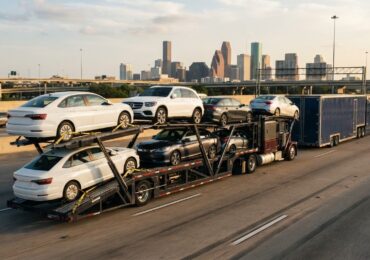
Choosing between shipping methods is a strategic decision that balances financial efficiency with asset preservation. Open transport car shipping remains the industry standard, accounting for approximately 95% of all automobile shipments in the United States. This method utilizes trailers that typically carry 7 to 10 vehicles at once, allowing carriers to distribute operational costs across multiple units. In contrast, enclosed car transport offers a premium service where vehicles are shielded from the elements. These specialized trailers usually move only 2 to 6 vehicles at a time, which directly contributes to the 30% to 60% price premium over open carriers.
To determine the most cost-effective choice, you should apply a “Protection ROI” framework. This involves comparing the open vs enclosed car transport cost against the potential financial loss from road wear or minor cosmetic damage. For a high-value asset, the extra investment in enclosed shipping is often significantly less than the cost of a professional paint correction or the depreciation caused by stone chips. However, for a standard vehicle, the savings of open transport often outweigh the statistical risk of minor road debris, which is already mitigated by comprehensive carrier insurance ranging from $100,000 to $250,000 per shipment.
When Open Transport is the Smart Choice
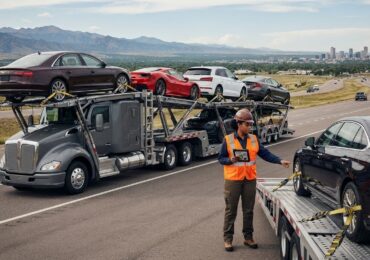
Open shipping is the most logical choice for daily drivers, older models, and budget-conscious relocations. There is a common myth that open trailers are inherently unsafe, but modern carriers utilize advanced soft-tie strapping systems that secure vehicles by the tires rather than the frame. This eliminates the risk of structural stress during transit. Because there are significantly more open trailers on the road, you’ll also benefit from faster scheduling and more flexible pickup dates, making it the most efficient option for standard household moves. If you want to understand exactly how these securement systems work in practice, our complete 2026 vehicle shipping guide covering car transport truck operations provides a detailed breakdown of the loading and safety protocols used by professional carriers.
The ROI of Enclosed Protection for High-Value Assets
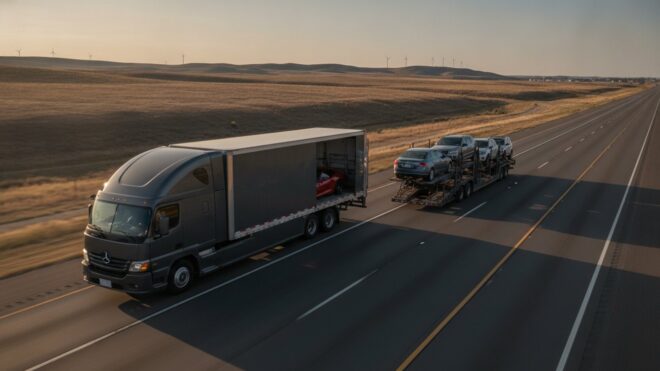
Vehicles valued above $75,000 generally warrant the investment in enclosed shipping. This service provides white-glove features, such as hydraulic lift gates that keep the vehicle perfectly level during loading and unloading. This is essential for low-clearance sports cars or exotics that might scrape on standard ramps. Hard-sided trailers also offer total security against severe weather, road salt, and theft. If your vehicle has a custom matte finish, an exposed interior, or a vintage engine bay, the enclosed method ensures the asset arrives in the exact condition it left, preserving its long-term market value and providing higher insurance coverage limits.
How to Spot Hidden Fees and Evaluate Quotes
Identifying a legitimate quote requires looking past the initial dollar amount to find the underlying service commitments. A common industry pitfall is the “Bait and Switch” pricing model, where a provider offers an unrealistically low estimate to secure a booking. Because these are often non-binding estimates, the price might “re-negotiate” upward once a carrier is actually assigned to your route. When evaluating the open vs enclosed car transport cost, you must ensure the quote is binding. A binding quote protects you from sudden market fluctuations and ensures the price you see is the price you pay at the point of delivery.
Logistical challenges at your specific location can also trigger unexpected surcharges. Many customers don’t realize that the massive 80 foot trailers used by auto transport carriers simply cannot navigate tight residential cul-de-sacs or streets with low-hanging branches. If a truck can’t safely reach your front door, a “Residential Access Fee” may apply to cover the cost of a smaller shuttle vehicle. You can avoid this by arranging to meet the driver at a nearby shopping center or large parking lot with easy highway access. If you want a transparent, all-inclusive estimate for your next move, request a detailed vehicle shipping quote from our team today.
The condition of your vehicle is another area where transparency is vital. As previously mentioned, inoperable vehicles require a surcharge, typically ranging from $150 to $400. This fee covers the specialized winching equipment and the extra labor time required for a driver to safely load a car that doesn’t roll, steer, or brake. Always disclose the exact condition of your vehicle upfront. Failing to do so can lead to “handling delays” or even a refusal of service at the pickup site, both of which result in significant extra costs.
Door-to-Door Logistics vs. Terminal Savings
Door-to-door service is the gold standard for convenience, as the carrier picks up and drops off the vehicle as close to your specified addresses as possible. While some companies suggest terminal-to-terminal shipping as a way to save money, these facilities often charge daily storage fees that quickly erase any initial savings. We recommend door to door car shipping for most 2026 shipments because it minimizes the number of times your vehicle is handled, which reduces the statistical risk of minor cosmetic wear during transit.
The All-Inclusive Quote Checklist
A professional, reliable quote should never leave you guessing about what’s included in the price. Before signing any contract, verify that the following five elements are explicitly covered: fuel surcharges, highway tolls, door-to-door service, cargo insurance, and applicable taxes. There is a significant legal difference between a binding quote and a non-binding estimate; always insist on the former to lock in your rate. Verifying a carrier’s DOT number and safety rating on the FMCSA website is a much more reliable indicator of service quality than simply choosing the lowest price on a spreadsheet.
Secure Your Vehicle with AutoPlex Transport’s Transparent Pricing
Deciding on a logistics provider involves more than just picking a name from a search result. It requires finding a partner that understands the high stakes of vehicle relocation. At AutoPlex Transport Company, we’ve developed a methodical quoting process designed to eliminate the ambiguity often found in the industry. We recognize that the open vs enclosed car transport cost is a significant part of your moving budget. Our commitment to transparency means we provide binding quotes that reflect the actual market conditions of 2026, ensuring you aren’t surprised by “re-negotiations” or hidden surcharges after your vehicle is already on the trailer.
Our status as a seasoned industry veteran allows us to prioritize safety and reliability over the low-balling tactics used by less experienced brokers. We maintain a robust nationwide reach, coordinating both open and enclosed logistics for a wide variety of vehicle classes. Whether you’re moving a standard daily driver or a high-value collector car, our team treats your asset with the same level of professional care. We’ve handled thousands of successful shipments, giving us the practical experience needed to manage complex routes and tight schedules with steady confidence.
Why Experience Matters in 2026 Logistics
The transportation industry has seen significant changes in 2026, particularly regarding insurance requirements and driver standards. We maintain a rigorous carrier vetting process that goes beyond simple license checks. We verify that every partner in our network carries high-standard cargo insurance coverage, typically ranging from $100,000 for open carriers to over $1,000,000 for specialized enclosed units. This detail-oriented approach to nationwide interstate transportation ensures that your vehicle is protected by a verified professional at every stage of the journey. We position ourselves as your reliable partner, offering a reassuring presence in what can often be a stressful transition.
Requesting Your Custom 2026 Quote
Getting an accurate rate for your move is a straightforward process when you have the right data. To provide a precise estimate, we only require a few key details: the year, make, and model of your vehicle, the pickup and delivery zip codes, and your preferred transport method. This information allows our logistics experts to calculate a rate that accounts for current fuel trends, route efficiency, and equipment availability. If you have specialized needs, such as a low-clearance vehicle or an inoperable car, we invite you to consult directly with our team. We’re here to help you transition from the research phase to a concrete, actionable shipping plan. Contact AutoPlex Transport Company today to secure professional vehicle transportation services tailored to your specific requirements.
Choosing the Right Path for Your Vehicle Relocation
Navigating the logistical shifts of 2026 requires a clear-eyed approach to budgeting and asset protection. You now have the framework to evaluate the open vs enclosed car transport cost based on your vehicle’s specific requirements, whether that means prioritizing the efficiency of an open carrier or the specialized security of an enclosed unit. True peace of mind comes from knowing your carrier is fully vetted and your quote is all-inclusive, protecting you from the deceptive pricing tactics that can often plague the industry.
AutoPlex Transport Company serves as your reliable partner throughout this process. We offer an extensive nationwide interstate shipping network and a strict no hidden fee guarantee, ensuring that the price we quote is the price you pay at delivery. Our team works exclusively with professional carrier partners who meet our rigorous safety and insurance standards. We’re ready to help you move forward with confidence and logistical clarity at every mile of the journey.
Get Your Transparent 2026 Car Transport Quote from AutoPlex Today
Your vehicle is a significant asset, and it deserves a transport plan that prioritizes safety and transparency. We look forward to providing the secure, professional service you need for a successful move.
Frequently Asked Questions
How much does it typically cost to ship a car cross-country in 2026?
The total investment for a cross-country move is determined by the total mileage and the current demand for that specific route. While cross-country trips have a higher total price than short-haul moves, they often benefit from a lower cost per mile. Factors like vehicle size, the time of year, and your choice of trailer will ultimately define the final rate you receive from a professional provider.
Is open carrier transport significantly cheaper than enclosed shipping?
Yes, open carriers are generally more affordable because they can transport up to ten vehicles simultaneously. This efficiency allows the carrier to distribute operational expenses across more units. The open vs enclosed car transport cost difference usually reflects a premium for the specialized equipment and lower vehicle capacity of enclosed trailers, which provide a higher level of individual protection.
Does the weight of an electric vehicle affect the car transport cost?
Heavy electric vehicle battery packs do influence shipping rates because they impact the trailer’s total weight capacity. Carriers must adhere to strict federal weight limits, and a load of heavy EVs may prevent them from filling every available slot on the rack. This loss of capacity is usually reflected in a weight surcharge for modern electric SUVs and sedans to cover the carrier’s lost efficiency.
What are the most common hidden fees in auto transport quotes?
Common hidden costs often stem from residential access challenges where a large truck cannot safely enter a neighborhood. You might also encounter “Bait and Switch” tactics where an initial quote is intentionally underpriced to secure your booking. To avoid these surprises, always ask for an all-inclusive, binding quote that explicitly lists fuel, insurance, and door-to-door service fees from the start.
Is insurance included in the car transport cost estimate?
Legitimate transport quotes should always include basic cargo insurance coverage. Open carriers typically provide coverage for the vehicle’s market value up to a specific limit, while enclosed carriers offer significantly higher protection for luxury or classic assets. Always verify the carrier’s insurance status and specific coverage limits on the FMCSA website to ensure your vehicle is fully protected during its journey.
How can I save money on car shipping without sacrificing safety?
You can reduce your expenses by being flexible with your pickup and delivery dates. Planning your move during off-peak months or meeting the driver at a large parking lot near a major highway also helps lower the carrier’s operational overhead. These small adjustments allow you to find a competitive open vs enclosed car transport cost without compromising on the quality of the carrier or the safety of your vehicle.
Why do car transport costs fluctuate during different seasons?
Rates fluctuate based on the seasonal demand for trailer space. The peak moving season from May through September often sees higher prices due to the sheer volume of families and students relocating. Winter weather also plays a role. Carriers may add surcharges for routes through regions prone to heavy snow and ice to account for slower travel times and increased operational risks during the colder months.
What is an inoperable vehicle surcharge and when does it apply?
An inoperable surcharge is a fee added when a vehicle cannot be driven onto the transport trailer under its own power. This covers the specialized equipment, such as a winch, and the extra labor required to load a car that doesn’t roll, steer, or brake. Disclosing this condition during the quoting process is vital so the carrier arrives with the correct tools to handle your vehicle safely. If you have concerns about the overall safety record of open transport methods, our detailed guide on whether open carrier transport is safe and how a car carrier vehicle actually protects your asset addresses the most common misconceptions with factual, data-backed analysis.