Your Report No Later Than Date (RNLTD) is a fixed point on the calendar that dictates your life for months, yet the logistics of moving your life across the country often feel anything but certain. You’ve likely spent hours wondering if the government will cover your vehicle or if you’ll be left navigating the process on your own dime. It’s a common frustration for service members who want to ensure their primary mode of transport arrives safely and on time. Shipping a car for military PCS shouldn’t be the most stressful part of your transition. We understand that your vehicle is more than just a machine; it’s a vital tool for your family’s daily life at a new installation.
This 2026 logistics guide is designed to help you master the complexities of military vehicle relocation with confidence. We’ll provide an expert breakdown of your current PCS entitlements, compare private shipping options like open and enclosed carriers, and provide a comprehensive preparation checklist. By the end of this article, you’ll know exactly how to manage your moving expenses within a DLA or PPM budget while ensuring your car is handled with professional care. We’ll walk through the specific steps needed to align your military orders with reliable transportation services so you can focus on out-processing and settling into your new home.
Key Takeaways
- Identify whether your 2026 orders qualify for government-funded vehicle transport by distinguishing between OCONUS and CONUS entitlements.
- Compare the cost-efficiency of open carrier shipping against the enhanced protection of enclosed transport for high-value personal vehicles.
- Streamline the process of shipping a car for military PCS by choosing door-to-door services that eliminate the need for terminal drop-offs.
- Follow a structured preparation checklist to ensure your vehicle is mechanically sound and your documentation is ready for a smooth transition.
- Align your vehicle’s arrival with your specific RNLTD by understanding how professional interstate logistics manage military timelines.
Understanding Your 2026 PCS Vehicle Shipping Entitlements
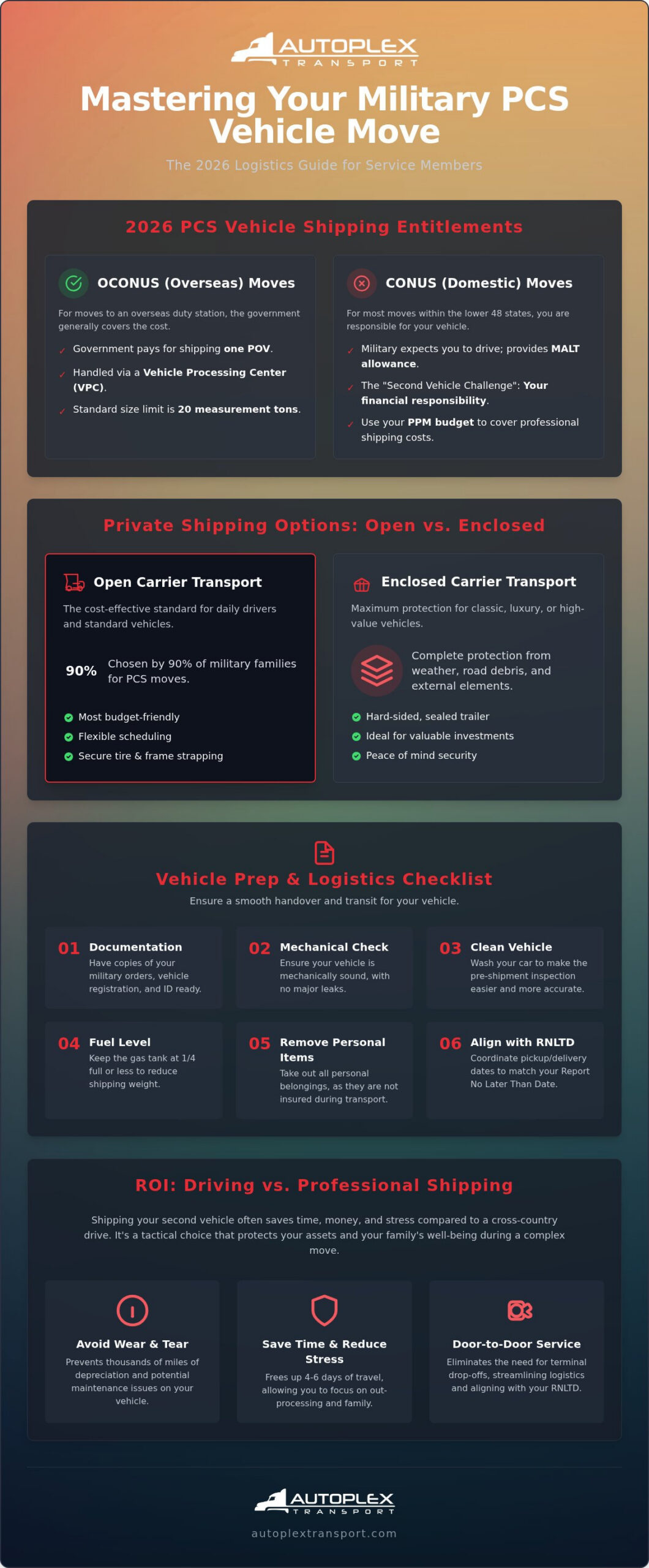
A Privately Owned Vehicle (POV) is defined by the military as any motor vehicle owned by a service member or their dependent intended for personal use. In the context of a Permanent Change of Station (PCS), the government provides specific allowances for moving these assets, but these entitlements are strictly regulated. The 2026 logistics landscape emphasizes efficiency and adherence to specific weight limits. You need to understand exactly where the government’s responsibility ends and yours begins to avoid unexpected out-of-pocket costs.
When Does the Government Pay for Shipping?
Eligibility for government-funded transport usually hinges on whether your orders are Outside the Continental United States (OCONUS). If you’re moving to an overseas duty station, the military typically pays for shipping one POV. You’ll interact with a Vehicle Processing Center (VPC), which acts as the hub for government-contracted transport. It’s vital to check 2026 POV weight and size limits, as oversized vehicles might incur extra fees. Generally, a standard POV shouldn’t exceed 20 measurement tons. For those transitioning to Hawaii, Bext Oahu offers premium Jeep rentals to bridge the gap while waiting for your vehicle to arrive, ensuring you have a capable ride for the island’s terrain from day one. If you have a documented medical necessity or a specific change in status, you might qualify for CONUS shipping, but this remains a rare exception.
The ‘Second Vehicle’ Challenge in CONUS Moves
Most domestic moves across the lower 48 states don’t include government-funded vehicle transport. The military expects you to drive your vehicle to your new station. This creates a logistical hurdle for two-car households. While you’ll receive a Monetary Allowance in Lieu of Transportation (MALT) for the car you drive, the second vehicle is your responsibility. Many families now use their Personally Procured Move (PPM) budget to manage the cost of shipping a car for military PCS.
Calculating the Return on Investment (ROI) of professional transport is a tactical move. Consider the following factors when deciding whether to drive or ship:
- Fuel and Lodging: The cost of gas, multiple hotel nights, and meals for a 2,000-mile trip adds up quickly.
- Vehicle Depreciation: Long-distance drives contribute significantly to wear and tear and high mileage.
- Time Constraints: Driving across the country can take 4-6 days, which is time you could spend out-processing or settling your family.
Often, the expense of a multi-day drive outweighs the cost of professional interstate vehicle transportation. By shipping the second car, you reduce the physical toll on your family and ensure you meet your RNLTD without the stress of a cross-country convoy.
Comparing Private Shipping Options: Open vs. Enclosed Carriers
When you’re managing the logistics of shipping a car for military PCS, the carrier type you choose dictates both your total spend and the level of protection your vehicle receives. It’s not just about moving an asset from point A to point B; it’s about ensuring your vehicle arrives in the same condition it left. At AutoPlex Transport Company, we help families weigh the cost-effectiveness of high-volume carriers against the specialized security of protected trailers to find the right fit for their specific situation.
Open Carrier: The Standard for Military Moves
Approximately 90% of military families select open transport car shipping for their primary daily drivers. These are the multi-car trailers frequently seen on interstate highways, capable of carrying up to ten vehicles at once. This method is the most budget-friendly option because operational costs like fuel and labor are shared across all units on the trailer. We utilize advanced safety strapping systems that secure each vehicle by its tires or frame, which prevents shifting during transit without putting unnecessary stress on the suspension. Because open carriers are more abundant in the national logistics network, they usually offer the most flexible scheduling for service members facing tight RNLTD deadlines.
Enclosed Transport: Protecting Your Investment
If you own a classic muscle car, a high-end sports car, or a heavily modified off-road vehicle, enclosed car transport provides a necessary layer of security. These trailers feature hard-sided walls that completely shield your vehicle from road debris, dust, and unpredictable 2026 weather patterns like severe hailstorms or heavy road salt during winter months. It’s a “white-glove” service designed for service members who view their POV as a significant financial investment rather than just a commuting tool. While the cost is higher than open transport, the added protection often justifies the expense when using a Personally Procured Move budget to handle high-value assets.
Your choice of carrier also influences your delivery timeline. Open carriers are more readily available, which often leads to faster pickup windows. Enclosed trailers are specialized equipment and are fewer in number, so they may require more lead time to schedule. Regardless of the carrier type, our priority is providing a professional and transparent experience that takes the guesswork out of shipping a car for military PCS. If you’re still deciding which carrier suits your vehicle’s requirements, you can speak with our logistics team to compare current route availability and protection levels.
The Logistics of Interstate Vehicle Transport for PCS
Mastering the logistics of interstate vehicle transport is essential for a successful transition. When you are shipping a car for military PCS, the process involves more than just loading a vehicle onto a trailer. It requires a coordinated effort between professional dispatchers and experienced drivers who understand the nuances of long-haul routes. Efficiency is the priority, as carriers must plan paths that maximize speed while adhering to strict safety regulations. Professional dispatchers serve as the tactical center of these operations, monitoring real-time traffic data and road conditions to ensure drivers stay on schedule despite the variables of the open road.
Navigating Long-Distance Routes
Common PCS corridors, such as moves from the East Coast to the West Coast, often follow established transit lanes that allow for predictable delivery windows. A typical cross-country journey might take 7 to 10 days, depending on the specific route and the number of stops. However, 2026 weather patterns, like late-season snow in the Rockies or heavy rain in the Southeast, can shift these schedules. Having nationwide transportation services ensures that no matter where your orders take you, there is a logistical path available. We prioritize safety over speed, ensuring that your vehicle isn’t put at risk during periods of severe weather or road construction.
Door-to-Door Convenience for Military Families
Door-to-door transportation offers a significant advantage for busy service members. Unlike terminal-to-terminal shipping, which requires you to drop off and pick up your car at a distant warehouse, this service brings the carrier as close to your residence as possible. This is particularly helpful when you’re managing tight pack-out dates and final housing inspections. It eliminates the need for extra trips and expensive rental cars during those final days at your old installation.
Managing delivery expectations around military bases requires specific planning. Many installations have restricted access for large multi-car carriers due to tight turns or security gate dimensions. If your destination base housing isn’t accessible for a 75-foot trailer, we coordinate a meeting at a nearby accessible location. Common meeting points include:
- Large retail parking lots just outside the main gate
- Rest areas along the primary approach corridor
- Wide residential streets with enough clearance for loading and unloading
This flexibility ensures that shipping a car for military PCS doesn’t become a bottleneck in your moving schedule. By coordinating the pickup and delivery around your specific timeline, we help you maintain your momentum during a complex relocation.
Step-by-Step Checklist: Preparing Your Car for a PCS Move
Preparation transforms a chaotic move into an organized transition. While government-contracted Vehicle Processing Centers (VPCs) often impose rigid, almost bureaucratic requirements, private door-to-door services offer a more streamlined approach. However, successful shipping a car for military PCS still requires meticulous attention to detail. You’ll want to ensure both the legal and mechanical aspects of your vehicle are ready before the carrier arrives at your driveway. Taking these steps early prevents last-minute delays that could interfere with your travel plans.
Documentation and Legal Readiness
Before the truck arrives, gather your vehicle’s title, current registration, and a copy of your military orders. These documents prove ownership and eligibility for transport. If your spouse is handling the hand-off while you’re already at the new duty station, a specific Power of Attorney is non-negotiable. Most carriers cannot legally accept a vehicle from anyone other than the registered owner without this legal authorization. You should also contact your insurance provider to verify that your policy remains active during the transit period. For a more detailed breakdown of these requirements, review our how to prepare a car for transport guide.
Physical Preparation and Safety
The “empty car” rule is one of the most important aspects of vehicle logistics. Federal regulations and insurance policies generally prohibit the transport of personal belongings inside a vehicle on an auto carrier. You must remove all loose items, including GPS units, dash cams, and garage door openers. Leaving only the spare tire and jack is the safest approach. We also require a fuel level of approximately 1/4 tank. This standard minimizes fire risk and reduces the total weight of the carrier, which is critical for staying within Department of Transportation weight limits.
Conduct a thorough mechanical inspection before pickup. Check for active leaks, ensure the battery is secured, and verify that the tires are properly inflated. On the day of transport, you and the driver will complete the Bill of Lading (BOL). This is your most important document. It records the exact condition of the vehicle at the time of pickup. We recommend taking high-resolution photos of all four sides, the roof, and the interior. This documentation provides peace of mind and serves as an undisputed record of the vehicle’s state before shipping a car for military PCS. If you’re ready to start the process with a team that understands the precision required for military moves, request a professional shipping quote today.
Why AutoPlex Transport is the Strategic Choice for Military Moves
Choosing a transportation provider is a tactical decision that directly impacts your entire relocation timeline. When you are shipping a car for military PCS, you need more than just a trailer; you need a partner who understands the rigidity of military orders. At AutoPlex Transport, we specialize in nationwide transportation services that cover every major installation in the contiguous United States. Our commitment to transparent logistics ensures that you stay informed from the initial pickup to the final delivery, providing a level of security that “cheap” alternatives simply cannot match.
Experience You Can Trust
Our methodical approach is designed to reduce the inherent stress of a cross-country move. We’ve spent years refining our interstate vehicle transportation processes to account for the unique pressure of the summer PCS season. While some providers offer low-ball quotes to win your business, these “cheap” options often lead to missed report dates and hidden fees when a driver can’t be secured. We prioritize professional communication and reliable scheduling because we know that a missed RNLTD has real consequences for your service record and your family’s transition.
By positioning ourselves as a reassuring partner, we move beyond the role of a standard carrier. We act as a knowledgeable guide, helping you navigate the complexities of shipping a car for military PCS with confidence. Whether you choose our open carrier car transportation for a daily driver or enclosed transport services for a prized vehicle, our goal is to provide a stable, experienced hand that manages your assets with the highest level of care.
Getting Your 2026 PCS Quote
Starting your journey with us is a straightforward, professional process. To receive the most accurate 2026 quote, you’ll need to provide specific details about your vehicle’s make and model, as well as your required pickup and delivery windows. Our online inquiry system is designed for simplicity, allowing you to secure your booking quickly so you can return your focus to out-processing and packing. We take the logistical burden off your shoulders by coordinating the door-to-door transportation details, ensuring your car is one less thing to worry about during your move; additionally, for help with large household items, Heavy Furniture Moving provides specialized support for bulky residential relocations.
Finalizing your vehicle logistics early allows you to plan your travel with certainty. Once your booking is confirmed, our dispatchers work behind the scenes to align your transport with the most efficient interstate routes. This proactive management ensures that your vehicle arrives safely and on time, allowing you to settle into your new assignment without delay. If you’re ready to experience a move handled with military-grade precision, we invite you to request your professional shipping quote and see the difference a reliable partner makes.
Securing Your Vehicle for the Next Assignment
Managing a move across the country is a significant undertaking, but it’s one you don’t have to navigate alone. By understanding the specific 2026 entitlements for OCONUS orders and recognizing when a private solution is necessary for CONUS moves, you’ve already taken the first step toward a successful transition. Choosing professional door-to-door logistics ensures your vehicle bypasses crowded terminals and arrives exactly where you need it. Shipping a car for military PCS becomes a streamlined, predictable process when you align your timeline with a partner who understands the high stakes of a report date.
AutoPlex Transport provides the expertise in long-distance interstate logistics and the methodical communication that military families deserve. We offer professional door-to-door national service to ensure your vehicle is handled with the same care you put into your service. When you’re ready to cross this item off your checklist, Get Your Professional Military PCS Shipping Quote from AutoPlex Transport. We’re here to support your move every mile of the way. Safe travels to your new duty station.
Frequently Asked Questions
Will the military pay to ship my second car during a CONUS PCS?
No, the military typically doesn’t pay for shipping a second vehicle during a domestic move. While you receive allowances for the car you drive, the second POV is an out-of-pocket expense. Many families use their Personally Procured Move (PPM) funds to cover the cost of shipping a car for military PCS. This strategy allows you to keep the family together in one vehicle while a professional carrier handles the other.
How far in advance should I book my military car shipping for a 2026 move?
We recommend booking your transport at least 30 days before your desired pickup date. The 2026 PCS season is expected to be busy, and early booking ensures we can secure a carrier that fits your specific RNLTD. If you’re moving during the peak summer months, providing a flexible three-day window for pickup helps us find the most efficient route and the most reliable driver for your relocation.
Can I ship personal items inside my car during a PCS move?
You cannot ship personal belongings inside your vehicle due to Department of Transportation regulations and insurance limitations. Carriers are licensed to transport vehicles, not household goods. Items left in the car aren’t covered by cargo insurance and add weight that can lead to fines at weigh stations. Always ensure your car is completely empty, aside from factory-installed equipment, before the driver arrives for pickup.
Do I need to be present for the pickup and delivery of my vehicle?
You or a designated representative must be present at both pickup and delivery to sign the Bill of Lading. This document is a legal record of your vehicle’s condition. If you can’t be there, you’ll need to provide a Power of Attorney to a trusted friend or spouse. This person will walk around the vehicle with the driver to document any existing wear and tear during the inspection.
What happens if my report date changes after I’ve scheduled shipping?
If your orders change, notify our logistics team as soon as possible to update your schedule. We understand that military timelines can be unpredictable, and we’ll work to adjust your pickup or delivery dates based on current carrier availability. While shifting dates might result in a price adjustment due to market demand, our priority is ensuring your vehicle arrives when you need it at your new installation.
How long does it typically take to ship a car cross-country for a PCS?
A cross-country shipment usually takes between 7 and 10 days from the time of pickup. Shorter interstate routes might only take 3 to 5 days. It’s important to remember that drivers are limited by federal hours-of-service regulations to ensure safety. We provide realistic delivery windows that account for distance and potential 2026 road conditions so you can plan your arrival with confidence and avoid unnecessary stress.
Is my vehicle insured while it’s being transported by AutoPlex?
Yes, your vehicle is protected by the carrier’s cargo insurance policy throughout the entire transit process. We verify that every driver in our network maintains high-level coverage to give you peace of mind. While shipping a car for military PCS is very safe, this insurance serves as a critical safeguard against rare incidents. We also recommend maintaining your personal auto insurance policy for the duration of the move.
Can I ship a vehicle to a military base if I’m living in base housing?
You can certainly ship a vehicle if you live on base, but the carrier might not be able to deliver directly to your front door. Large multi-car trailers often struggle with the narrow streets and security gates found in base housing. In these cases, we coordinate a meeting at a nearby parking lot or a wide street just outside the installation. This ensures a safe and efficient unloading process for everyone.