

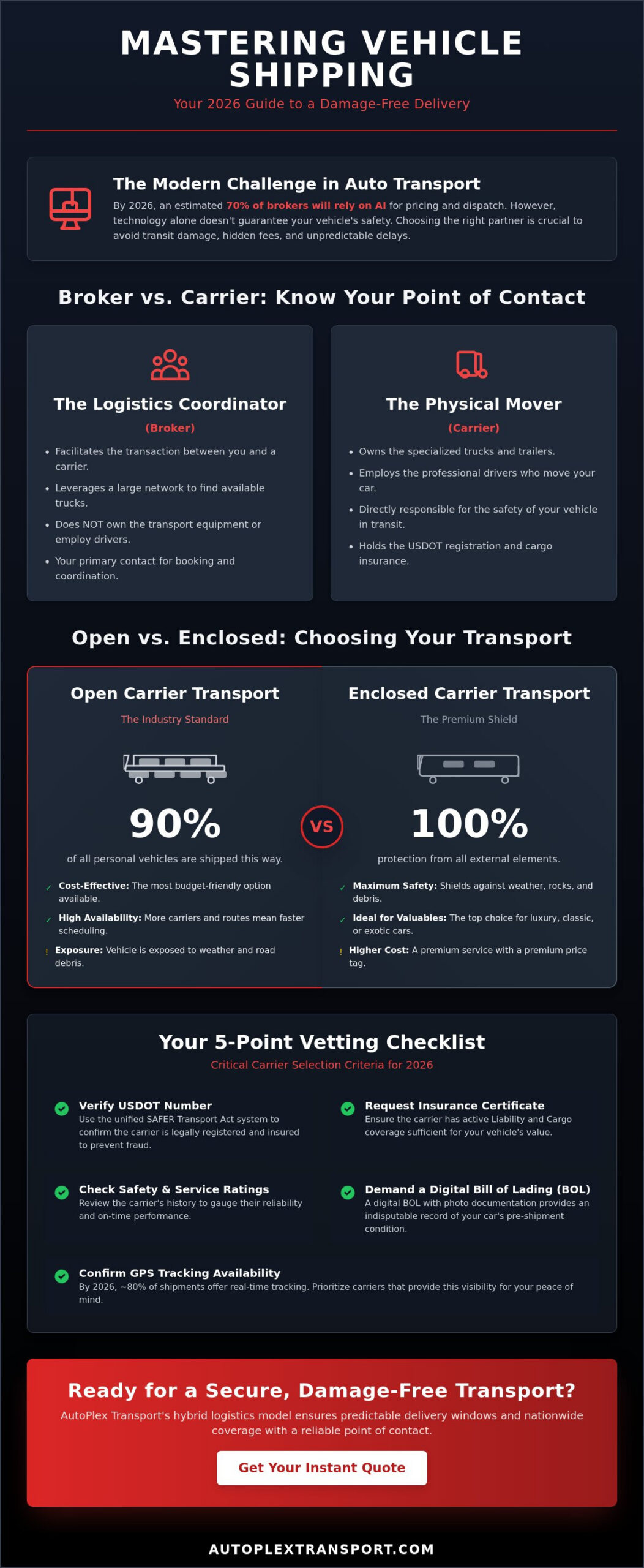
By the end of 2026, an estimated 70% of auto transport brokers will rely on AI for pricing and dispatch, yet technology alone cannot guarantee your vehicle’s safety during transit. When researching open carrier transport options for your vehicle’s relocation, you quickly realize that logistical expertise is more valuable than an automated quote. Choosing the wrong partner often leads to the very things you fear most, such as transit damage or unpredictable delivery windows that disrupt your entire schedule.
It’s natural to feel protective of your vehicle, especially when navigating the confusion between brokers and carriers or worrying about hidden insurance gaps. AutoPlex Transport Company understands these concerns. This guide will help you master the logistics of vehicle shipping and teach you how to evaluate auto transport carriers to ensure your car arrives safely and on budget. We will explore how to verify USDOT numbers under the 2026 SAFER Transport Act and provide a clear roadmap for achieving a damage-free delivery with a reliable point of contact throughout the journey.
Key Takeaways
- Identify the critical operational differences between carriers and brokers to establish a reliable point of contact for your vehicle’s journey.
- Evaluate the specific advantages of open carrier transport Houston to determine if this budget-friendly method meets your vehicle’s safety profile.
- Implement a rigorous vetting process using updated 2026 regulatory standards to verify carrier insurance and safety ratings before booking.
- Understand why a hybrid logistics approach can offer more predictable delivery windows and broader nationwide coverage than limited direct-carrier models.
- Learn how to avoid hidden insurance gaps and freight fraud by verifying USDOT numbers through the unified system introduced in the SAFER Transport Act.
What Are Auto Transport Carriers and How Do They Operate?
A carrier is the physical entity that owns specialized equipment and employs the drivers who move your vehicle. Unlike brokers who facilitate the transaction, carriers are the boots on the ground. In 2026, the industry has shifted toward higher transparency and digital integration. If you are booking open carrier transport Houston services, the carrier is the company responsible for the safety of your asset from the moment it’s loaded onto the car carrier trailer until it reaches its destination. They serve as the backbone of the national logistics infrastructure, ensuring that inventory moves between dealerships, auctions, and private residences across the country.
There is a distinct difference between local transport and long-haul interstate operations. Local carriers often handle last-mile deliveries or short regional hops. Long-haul interstate operations require more complex logistics, as drivers must manage strict hours-of-service regulations and coordinate multi-car drop-offs. While focusing on your vehicle’s transit, if you also need luxury personal transport in the nearby Dallas-Fort Worth Metroplex, you can learn more about 1Executive Car for professional chauffeur services.
The Core Functions of a Professional Carrier
The process begins with a rigorous vehicle inspection. This results in the Bill of Lading (BOL), which serves as both a receipt and a condition report. By 2026, most professional carriers have transitioned to digital BOLs that allow for instant photo documentation and electronic signatures. This technology reduces disputes and ensures you have a real-time record of your car’s status. Beyond paperwork, carriers use sophisticated software for multi-car trailer optimization. This ensures that vehicles are loaded in a specific sequence to maximize weight distribution and fuel efficiency while preventing any physical contact between vehicles during transit.
Understanding insurance is equally vital. A professional carrier carries two distinct types of coverage. Liability insurance protects against damage caused by the driver or the truck itself, while cargo insurance specifically covers the vehicles being transported. Reliable providers maintain high coverage limits to give customers peace of mind during the journey. You should always ask for a certificate of insurance to verify that the carrier’s policy is active and sufficient for your vehicle’s value.
The National Reach of Modern Car Shipping
Operating across state lines involves more than just driving. Carriers must navigate varying interstate regulations and stop at weight stations to ensure they comply with federal safety standards. Seasonal demand also plays a significant role in how these companies operate. During the peak summer months, carrier availability tightens, which often requires more advanced planning for those seeking open carrier transport Houston solutions. By 2026, approximately 80% of car shipments include real-time GPS tracking, allowing you to monitor your vehicle’s progress as it moves through the national highway system.
An auto transport carrier is a legally recognized entity required by federal law to maintain active USDOT registration to operate as a for-hire hauler.
Open vs. Enclosed Carriers: A Comparative Analysis
Deciding between open and enclosed transport involves balancing financial considerations with the specific protection needs of your vehicle. While both methods provide safe transit, they utilize different equipment and operational strategies to move cars across the country. The choice often comes down to matching your car’s vulnerability profile with the right trailer type. For most owners, the decision is a practical one based on the vehicle’s age, value, and intended use after delivery.
Open Carrier Transport: The Industry Standard
Open transport car shipping remains the preferred choice for roughly 90% of all daily drivers. This method typically utilizes a 10-car “stinger” trailer, a structural powerhouse designed for maximum efficiency. When you book open carrier transport Houston, you’re choosing a solution that is both reliable and cost-effective. It’s the same method manufacturers use to deliver new cars to dealerships. While it’s true that the vehicle is exposed to weather and road debris, professional drivers use strategic loading patterns to minimize these risks. It’s the logical choice for standard sedans and SUVs where the higher cost of enclosed shipping doesn’t provide a proportional increase in utility.
Enclosed Carrier Transport: The Premium Shield
For those with luxury, classic, or high-value assets, enclosed car transport offers a higher tier of security. It’s essential to distinguish between soft-side and hard-side trailers. Soft-side trailers use heavy-duty vinyl curtains to block most debris, while hard-side trailers offer a solid metal shell for total environmental protection. Another critical factor is the loading mechanism. While many trailers use ramps, premium enclosed haulers often use hydraulic lift gates. These gates keep the vehicle perfectly level during loading. This is a non-negotiable feature for low-clearance sports cars or heavy electric vehicles that require precise handling.
In 2026, electric vehicles are expected to represent 35% of all shipments. These high-value assets often justify the enclosed premium, which typically ranges from 30% to 60% above standard rates. To make a fully informed decision, it helps to understand the complete breakdown of open vs enclosed car transport cost so you can weigh the physical risks of the road against your specific budget requirements. If you plan to sell a collector car, the “shipped enclosed” status can actually preserve its resale value by preventing even minor cosmetic wear from road salt or rain. For a standard commuter vehicle, the significant savings of open carrier transport Houston are usually the smarter financial move. If you’re unsure which method fits your specific route, you can speak with a logistics expert to weigh your options based on your car’s specific requirements.
Direct Carriers vs. Brokers: Navigating the Logistics Chain
Many first-time shippers believe that working directly with a truck owner is the most efficient path. However, the reality of national logistics is far more complex. A single carrier might only have a few trucks on a specific route. If you need open carrier transport Houston services on a specific date, that single owner-operator might be three states away. This is where the managed logistics model provides a significant advantage. A professional partner acts as your logistics manager, vetting thousands of carriers to find the one that matches your timeline and equipment needs.
The relationship between the customer, the broker, and the carrier is a structured chain designed for safety and efficiency. The broker handles the administrative vetting, insurance verification, and scheduling. The carrier focuses on the physical movement of the vehicle. This hybrid model provides better national coverage than a single-truck operation could ever achieve on its own. It allows for a more flexible response to shifting demands and route changes while maintaining a high standard of safety.
The Benefits of a Managed Carrier Network
A managed network offers a level of redundancy that a solo carrier cannot match. If a truck experiences a mechanical failure mid-route, a managed network can quickly coordinate a replacement to ensure your vehicle isn’t stranded. This system also provides access to a wider variety of specialized equipment. Whether you need a standard multi-car hauler or a specific configuration for an oversized SUV, a managed network has the reach to find the right fit. Dispatchers play a crucial role here, maintaining delivery schedules and serving as your primary point of contact so you aren’t trying to reach a driver who is focused on the road.
Avoiding the ‘Ghost Carrier’ Scam
The industry occasionally sees “ghost carriers” who offer unusually low quotes to lure in customers. These entities often lack proper insurance or FMCSA credentials. A reliable logistics partner verifies these details on your behalf. They check safety ratings and cargo insurance limits before a single vehicle is loaded. If a quote seems significantly below the market average, it’s often a red flag for a bait-and-switch tactic. Maintaining a centralized point of contact for nationwide shipping ensures that you have accountability and transparency throughout the entire journey. You should always feel confident that the person managing your shipment has a proven history of success and a commitment to protecting your interests.
A managed network provides a layer of professional oversight and equipment redundancy that a single-truck owner-operator simply cannot offer on a national scale.
Vetting Your Carrier: Critical Selection Criteria for 2026
Safety in the auto transport industry isn’t a matter of luck. It’s the result of rigorous vetting and adherence to federal standards. In 2026, the landscape has changed with the introduction of the SAFER Transport Act on February 26. This act was designed to combat freight fraud by phasing out traditional MC numbers in favor of a unified USDOT number system. When you are evaluating open carrier transport Houston providers, your first step should be verifying this unified number through the Federal Motor Carrier Safety Administration (FMCSA) SAFER system. This database provides a transparent look at a company’s safety history and current legal standing.
Beyond the unified number, you should confirm that the carrier is compliant with the latest safety regulations. As of January 10, 2026, all motor carriers must verify their drivers’ medical certifications exclusively through Motor Vehicle Records. This shift ensures that every driver behind the wheel of a multi-car hauler is physically fit for long-haul duty. If a company can’t explain how they maintain these safety standards, they may not be the reliable partner you need for your vehicle’s journey.
Technical Verification: DOT and MC Numbers
Using the SAFER system allows you to check more than just a number. It reveals the carrier’s insurance status. You must verify that their insurance authority is “Active” and covers the full value of your cargo. Liability insurance is standard, but cargo insurance is the specific policy that protects your vehicle against transit damage. Don’t settle for a verbal confirmation. Ask for a copy of their insurance certificate. Additionally, check for a high rating from the Better Business Bureau. An ‘A’ rating from the BBB serves as a strong indicator that the company values professional resolution and logistical transparency.
Operational Transparency
Operational details often separate professional carriers from cut-rate alternatives. Most modern clients prioritize Door 2 Door Transportation because it minimizes the risks associated with terminal-to-terminal shipping. Terminals can be crowded, unmonitored lots where vehicles are moved multiple times by different staff. Door-to-door service ensures your car stays on the same trailer from pickup to delivery. For a deeper understanding of how securement technology and loading procedures protect your vehicle throughout this process, the complete 2026 guide to using a car transport truck covers the specific mechanics behind safe door to door car shipping Houston and beyond. When selecting open carrier transport Houston services, real-time tracking is no longer a luxury but a necessity for security. By 2026, roughly 80% of car shipments include real-time GPS tracking as a standard feature, allowing you to monitor your vehicle’s progress across the country.
Finally, examine the cancellation and refund policies. A trustworthy company provides a clear, written contract that protects your deposit if a carrier can’t be secured. Avoid any provider that uses high-pressure tactics or demands large, non-refundable upfront fees. Transparency in these policies is a hallmark of a seasoned industry veteran who prioritizes your peace of mind over a quick sale.
Why AutoPlex Transport Leads in National Carrier Solutions
Choosing a shipping partner is a decision rooted in trust and logistical competence. At AutoPlex Transport Company, we’ve built our reputation on a methodical, safety-first approach that treats every vehicle as a priority asset. We understand that while you need the logistical reach of a nationwide network, you also deserve the attentive care of a boutique provider. This balance allows us to offer the reliability of large-scale open carrier transport Houston operations while maintaining a direct line of communication with our clients. We don’t just move cars; we manage the entire logistical chain to ensure your vehicle arrives exactly as expected.
Our vetting process is among the most rigorous in the industry, specifically designed to address the complexities of the 2026 regulatory environment. AutoPlex Transport Company has updated its internal standards to align with the SAFER Transport Act, ensuring every carrier in our network operates under a verified, unified USDOT number. We also confirm that drivers meet the new federal requirements for digital medical certifications before they are assigned to a route. This attention to detail means that when you book with us, you’re working with a partner that has already completed the heavy lifting of compliance and safety verification.
Comprehensive Service for Every Vehicle Type
Whether you’re moving a daily driver or a high-value collectible, AutoPlex Transport Company matches the carrier equipment to the specific needs of the car. For standard sedans and SUVs, our open carrier transport Houston routes offer interstate efficiency that keeps your move on schedule and within budget. For more sensitive assets, we provide specialized handling that prioritizes maximum protection. Our focus on proactive communication helps reduce the anxiety often associated with long-distance shipping. You’ll receive regular updates, ensuring you’re never left wondering about your vehicle’s location during its cross-country journey.
Start Your Shipment with Confidence
Beginning your transport journey should be a straightforward and transparent process. We’ve designed our system to provide accurate, no-obligation quotes that reflect current market conditions and fuel costs. To ensure a successful transit, we recommend a few simple preparation steps: wash your vehicle for a clear initial inspection, remove all personal items, and ensure the battery is charged. These small actions help our carriers maintain the highest levels of safety and efficiency. When you’re ready to experience a higher standard of vehicle logistics, get your professional auto transport quote from AutoPlex Transport Company today.
Securing a Reliable Path for Your Vehicle Transit
Managing the shifts in 2026 vehicle logistics requires a partner who understands the updated legal and operational landscape. You’ve now gained the necessary tools to distinguish between brokers and carriers, verify USDOT credentials through the new unified system, and select the equipment that best matches your car’s vulnerability profile. These steps are the foundation of a successful, stress-free shipping experience that prioritizes safety over the lowest possible price.
Whether you are coordinating open carrier transport Houston or moving a high-value asset across the country, AutoPlex Transport Company is ready to manage the details. We maintain an A+ BBB rating and provide fully licensed and insured nationwide door-to-door service. Our methodical approach ensures that every carrier in our network meets the highest standards of safety and reliability. We take pride in being a steady hand in a complex industry, protecting your investment at every mile.
Request a Professional Auto Transport Quote today and move forward with the peace of mind that your vehicle is in expert hands. We look forward to being your trusted partner on the road ahead.
Frequently Asked Questions
What is the difference between an auto transport carrier and a broker?
A carrier is the company that owns the physical trucks and employs the drivers who haul your vehicle, while a broker acts as a logistics manager to connect you with a vetted hauler. Brokers provide access to a nationwide network and handle the administrative vetting process to ensure your vehicle is matched with a driver who has the correct equipment. This managed approach offers better redundancy and scheduling flexibility than working with a single owner-operator.
How much insurance coverage do auto transport carriers typically provide?
Professional carriers typically maintain cargo insurance policies ranging from $100,000 to $250,000 per load, depending on the trailer type and company size. This specific coverage protects your vehicle against transit damage, while separate liability insurance covers damage caused by the truck itself. You should always verify that a carrier’s insurance authority is active through the FMCSA SAFER system before your vehicle is loaded onto a trailer.
Can I leave personal items inside my car during transport?
You should remove all personal belongings from your vehicle because carriers are not legally licensed to transport household goods. Most cargo insurance policies do not cover items left inside the cabin, and excess weight can lead to fines at federal weight stations. Removing these items prevents interior damage and ensures the carrier remains within the strict weight limits required for safe interstate travel across the country.
How do I track my vehicle while it is with the carrier?
By 2026, approximately 80% of car shipments include real-time GPS tracking that allows you to monitor your vehicle’s progress through a customer portal. When you book open carrier transport Houston, you will receive a tracking link or a dedicated point of contact for updates. This transparency ensures you know exactly where your car is during its 2,000+ mile journey, providing peace of mind from pickup to delivery.
What happens if my car is damaged during transit?
You must document any new damage on the Bill of Lading (BOL) at the time of delivery to initiate a valid insurance claim. It’s essential to take clear, dated photos of your vehicle at both pickup and drop-off to serve as evidence for the insurance provider. A reliable transport partner will guide you through the claims process and work with the carrier’s insurance company to ensure repairs are handled professionally.
How long does it take for a carrier to ship a car cross-country in 2026?
A cross-country shipment typically takes between 7 and 10 days, depending on the specific route, weather conditions, and federal hours-of-service regulations. Drivers must adhere to strict rest requirements to maintain safety standards on the road. You will receive an estimated delivery window when you book, and your point of contact will provide updates if traffic or road conditions impact the arrival time at your destination.
Is door-to-door transport available for all vehicle types?
Yes, door-to-door service is available for standard sedans, SUVs, luxury cars, and electric vehicles. This method is the most secure option as it minimizes the number of times your car is moved or handled. If your residential street is too narrow for a large multi-car hauler to enter safely, the driver will coordinate a nearby meeting point, such as a large parking lot, to complete the delivery.
How do carriers handle electric vehicle (EV) transport differently?
Carriers use specialized loading techniques for electric vehicles to manage their unique weight distribution and lithium-ion battery safety requirements. In 2026, EVs account for roughly 35% of all shipments, and drivers are trained to handle these high-value assets with extra care. When arranging open carrier transport Houston for an EV, ensure the battery is charged to at least 25% so the driver can safely load and unload the vehicle.