
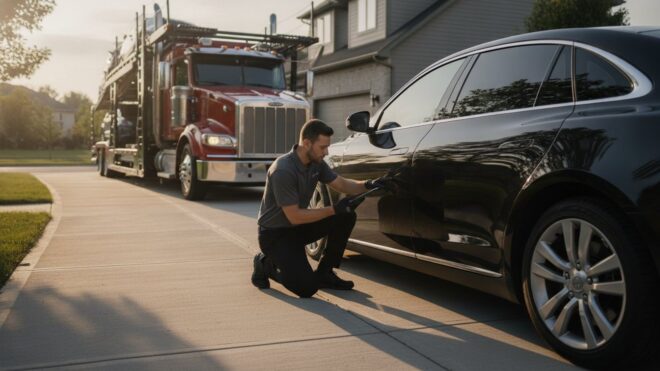
Did you know that the most critical phase of your vehicle’s journey happens before the carrier even pulls into your driveway? Many owners assume a quick wash is enough, but learning how to prepare a car for transport is actually a technical and legal audit designed to secure your insurance coverage. It is perfectly normal to feel some anxiety about transit damage or confusion over which personal items can stay in the cabin, especially since carrier insurance typically provides zero coverage for personal belongings left inside.
We understand that your vehicle is a significant asset, and you need a reliable partner to guide you through the logistical complexities of modern shipping standards. This methodical roadmap provides the exact steps you need to take to ensure your car is protected, documented, and ready for a seamless nationwide move. We will walk you through a professional checklist that covers everything from the essential Bill of Lading inspection to the latest 2026 digital verification requirements, giving you the confidence that your vehicle will be accepted without delays or disputes.
Key Takeaways
- Learn the 2026 digital standards for ownership verification and why maintaining cloud-based copies of your documentation is essential for a smooth pickup.
- Discover the professional requirements for exterior and interior preparation, including which non-factory accessories must be removed to prevent transit damage.
- Understand the industry-standard “Quarter-Tank Rule” and the specific mechanical checks that ensure your carrier can safely load and unload your vehicle.
- Master how to prepare a car for transport by perfecting the Bill of Lading process and using high-resolution digital evidence to safeguard your insurance claims.
- Identify the critical differences between preparing for open and enclosed carrier services to ensure your vehicle receives the appropriate level of protection.
Essential Documentation and Insurance Verification
Professional auto transport is a highly regulated industry that requires more than just a set of keys to initiate a shipment. When you begin researching how to prepare a car for transport, you will find that the process starts with a legal handoff. Carriers must verify ownership to comply with federal regulations and prevent the illegal movement of vehicles across state lines. Without the correct paperwork, a driver may refuse to load your vehicle, leading to costly delays and missed pickup windows.
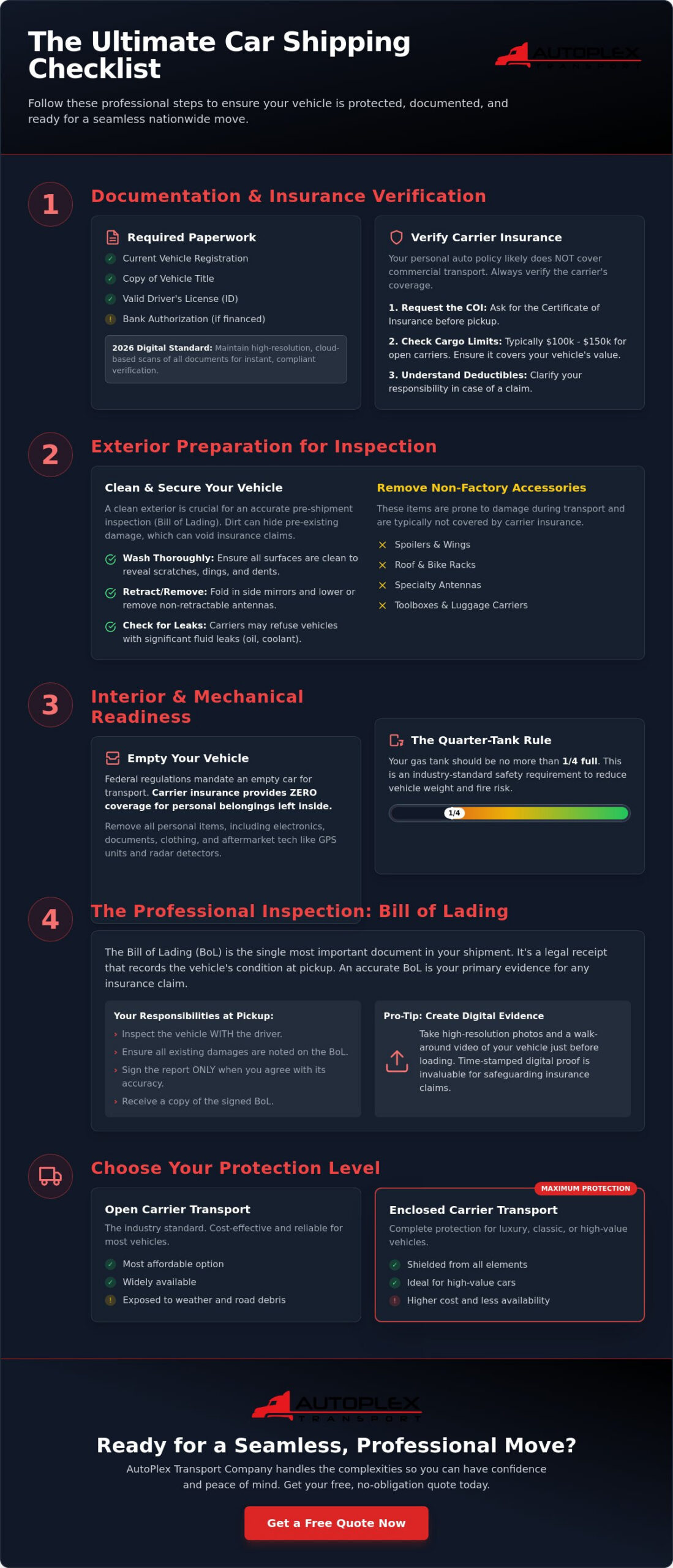
The Department of Transportation (DOT) mandates specific documentation for every commercial vehicle move. As of 2026, the industry has fully transitioned to digital verification standards. While physical copies are useful, maintaining cloud-based, high-resolution scans of your title and registration is now the professional standard. This ensures that your documentation is accessible even if physical copies are misplaced during your own move. It also allows for instant verification if a carrier faces a roadside inspection by DOT officials.
The Prerequisites: Title, Registration, and ID
Your vehicle’s registration must be current before it’s loaded onto a trailer. If your registration is expired, you risk complications during interstate transport, as law enforcement can flag vehicles with lapsed tags during routine carrier inspections. You should also provide a clean, legible copy of your driver’s license to the transport coordinator. If you are shipping a financed vehicle, check your contract for nationwide transit clauses. Many lenders require a formal bank authorization letter before a car can be moved long distances, especially for Interstate Vehicle Transportation. Having these documents ready in a dedicated digital folder is a vital step in how to prepare a car for transport effectively.
Verifying Carrier Insurance and Liability
A common mistake is assuming your personal auto policy provides full coverage during professional transit. In most cases, personal policies exclude damage occurred while the vehicle is in the care of a commercial carrier. You must ask for the carrier’s Certificate of Insurance (COI) well before the pickup date. Review the cargo insurance limits, which typically range from $100,000 to $150,000 for open carriers. It is also important to understand your deductible responsibilities. While the carrier’s policy should cover transit damage, some contracts include clauses that pass a portion of the deductible to the owner. Contingent cargo insurance is an added layer of protection provided by professional brokers that acts as a secondary safety net if the carrier’s primary policy is found to be deficient or expired.
Exterior and Interior Preparation for Maximum Protection
A common misconception is that washing your car before shipping is merely for aesthetics. In reality, a clean exterior is the foundation of a legally binding inspection. When you’re learning how to prepare a car for transport, you must prioritize visibility. Dust, road grime, and mud can easily mask small dents or hairline scratches. If these imperfections aren’t visible during the initial pickup, they cannot be documented on the Bill of Lading. This oversight makes it nearly impossible to prove that damage occurred during transit, potentially voiding your ability to file a successful insurance claim.
Professional carriers also have strict safety protocols regarding exterior add-ons. Non-factory accessories like large spoilers, bike racks, and specialty antennas are prone to catching on the trailer structure or vibrating loose during Nationwide Transportation Services. You should remove these items entirely or secure them if removal isn’t possible. If you’re unsure about a specific modification, our team at AutoPlex Transport Company can provide guidance on whether your vehicle requires specialized handling or additional preparation.
Exterior Detailing for the Pre-Load Inspection
A professional-grade wash allows the driver to conduct an accurate assessment in minutes. Beyond the paint, you should retract side mirrors and lower or remove any non-retractable antennas to minimize the vehicle’s footprint on the trailer. It’s also vital to check for active fluid leaks. Carriers may refuse vehicles with significant oil, coolant, or transmission fluid drips. These leaks don’t just damage the trailer; they can drip onto other high-value vehicles loaded below yours, creating a massive liability for the driver and the carrier.
Securing the Cabin and Removing Tech Accessories
The 2026 “Empty Car” rule is strictly enforced across the industry. Federal regulations prohibit carriers from transporting personal belongings inside the cabin because their insurance provides exactly $0 in coverage for these items. Beyond insurance risks, extra weight can push a carrier over legal limits at weigh stations. You should clear out all aftermarket tech, including GPS units, dash cams, and loose charging cables. Don’t forget to remove toll tags and parking passes. If left on the windshield, these devices can be triggered by sensors as the carrier moves through interstate toll booths, leading to unexpected charges on your account. The only items legally allowed to remain are those essential to the vehicle’s operation, such as the spare tire, jack, and emergency kit stored in the trunk. This ensures you’ve followed the professional standard for how to prepare a car for transport without risking your personal property.
Mechanical Readiness and Fuel Level Requirements
Ensuring your vehicle is mechanically sound is just as critical as organizing your paperwork or detailing the exterior. When you research how to prepare a car for transport, you will find that the physical state of the engine and tires dictates how safely a driver can load your asset. A vehicle that fails to start or loses braking power during the loading process creates a hazardous environment and often results in significant delays or additional “inoperable” fees. By taking a methodical approach to mechanical readiness, you ensure a smooth handoff and protect the carrier’s equipment.
The “Quarter-Tank Rule” is an industry standard that balances two competing needs. Professional carriers prefer your gas tank to be approximately one-quarter full. This provides enough fuel for the driver to maneuver the vehicle onto the trailer while significantly reducing the total weight of the load. Every gallon of gasoline adds roughly six pounds to the trailer’s weight. On a multi-car carrier, full tanks can push the entire rig over federal weight limits, leading to fines and logistical setbacks at weigh stations. Additionally, you should disable all alarm systems before the carrier arrives. The constant vibration of the trailer during Interstate Vehicle Transportation can trigger sensitive alarms, which will drain your battery and create an unnecessary distraction for the driver.
Preparation steps can vary slightly depending on your chosen service level. While open transport car shipping is the most common choice, vehicles with low ground clearance may require extra care, such as checking that spoilers or under-body panels are securely fastened. For owners of rare classics, luxury vehicles, or any asset you wouldn’t want exposed to road debris and harsh weather, exploring enclosed car transport services is a worthwhile step before finalizing your shipping plan. Owners of high-value vehicles in the Texas region should also consider reviewing the specialized options available through luxury car transport Houston services, which are specifically designed to protect premium assets from road debris and unpredictable weather conditions. Regardless of the carrier type, your vehicle must be in a state where it can be handled safely by a professional driver who may not be familiar with your car’s specific quirks.
The 2026 EV Preparation Protocol
Electric vehicles (EVs) require a specialized approach to battery management during transit. In 2026, the professional safety standard for shipping an EV is maintaining a State of Charge (SoC) between 45% and 60%. This range is considered the “sweet spot” for safety, as it minimizes the risk of thermal events while ensuring the battery doesn’t drop to zero during long-haul moves. You must also disable features like “Sentry Mode” or “Summon” before pickup. These active monitoring systems consume significant energy and can deplete the battery over a week-long journey. Finally, ensure your key card or fob is fully functional so the driver can access the vehicle’s transport mode without delay.
Standard Mechanical Checklist
Before the pickup date, verify that your vehicle meets the “Operable” standard. This means the car must start, stop, and steer under its own power. If your vehicle has a specific “trick” to get it started, you should provide these instructions to the driver in writing. Tire pressure is equally important. Over-inflated or flat tires pose a safety risk during the tie-down process on the trailer. Ensure all tires are at the manufacturer’s recommended PSI to provide a stable foundation for the duration of the trip.
The Professional Inspection: Mastering the Bill of Lading
The Bill of Lading (BOL) is the most important document you will handle during the entire shipping process. It serves as your official receipt and a comprehensive condition report that protects both you and the carrier. When you are finalizing how to prepare a car for transport, you must treat the inspection as a formal legal audit. A casual glance is never sufficient. You and the driver must perform a joint walk-around to identify every existing imperfection. This is where your previous efforts in cleaning the car pay off, as the driver can clearly see and document the vehicle’s true state before it is loaded onto the trailer for professional auto transport services.
In 2026, the industry has moved beyond simple paper diagrams. Digital inspections are now the norm, allowing for precise timestamped records that are much harder to dispute than a handwritten note. You must never sign a “blank” or “incomplete” Bill of Lading. Doing so gives the carrier permission to fill in the condition report later, which could lead to pre-existing damage being omitted or new damage being attributed to you. If you are ready to begin your journey with a partner who values transparency, you can request a quote from AutoPlex Transport Company today.
Photographic Evidence: The 360-Degree Strategy
Capture a full 360-degree view of your vehicle immediately before the carrier arrives. You need date-stamped photos of the roof, the undercarriage, and all four corners to ensure no angle is left undocumented. Don’t forget the interior; take clear close-ups of the odometer and the dashboard while the engine is running to prove there are no active warning lights or mechanical issues. Video evidence should include a slow walk-around of the vehicle while it is still on the ground. This provides a continuous, unedited record of the car’s condition that static photos alone might miss during a claim process.
Signing the Bill of Lading with Confidence
Review the driver’s diagram with extreme care before adding your signature. Ensure every tiny chip, scratch, or dent you identified is clearly marked with the correct corresponding code. If the driver misses an existing blemish, insist that it be added to the report immediately. You also need to verify that the pickup and delivery addresses match your shipping agreement exactly to avoid logistical confusion. If there is a discrepancy between your assessment and the driver’s notes that cannot be resolved on the spot, make a specific note of your disagreement in the comments section of the BOL. This creates a paper trail that is vital if you ever need to file an insurance claim after delivery.
Partnering with AutoPlex Transport Company for a Seamless Move
While mastering how to prepare a car for transport is primarily the owner’s responsibility, you don’t have to manage the process alone. A successful move relies on a synergy between your meticulous preparation and our methodical approach to logistics. At AutoPlex Transport Company, we view ourselves as your reliable partner, providing the professional oversight necessary to ensure your vehicle is handled with the highest level of care. From the moment you request your initial quote, we prioritize transparent communication to eliminate the anxiety often associated with long-distance vehicle moves.
Our team specializes in coordinating both Open Carrier Car Transportation and high-value enclosed car carrier transport. We understand that different vehicles require different levels of protection. Whether you are shipping a daily driver or a vintage collectible, we apply the same rigorous vetting process to every carrier in our network. This commitment to quality ensures that your vehicle is only ever placed in the hands of seasoned professionals who respect the documentation and mechanical standards we have discussed throughout this guide. For customers in the greater Houston area shipping a premium vehicle, our dedicated luxury car transport Houston service provides an additional layer of specialized care tailored to high-value automotive assets.
Our Professional Standards for Nationwide Logistics
We manage Interstate Vehicle Transportation by partnering exclusively with carriers who are fully licensed and bonded. This is a non-negotiable standard for our Nationwide Transportation Services. Our “Reliable Partner” approach is particularly beneficial for customers utilizing our Door 2 Door Transportation options. Instead of navigating complex terminal drop-offs, you receive a personalized service where a professional shipping consultant is available to provide real-time updates. This level of support ensures that the logistical complexities of 2026 shipping regulations are handled on your behalf, allowing you to focus on the other aspects of your relocation.
Schedule Your Professional Consultation
Taking the final step in your transport journey is straightforward. To receive an accurate, binding vehicle shipping quote for 2026, you simply need to provide your vehicle details and desired timeframe. Our team doesn’t just give you a number; we guide you through the final 24 hours of vehicle preparation to ensure nothing is overlooked. We will help you verify that your digital documentation is ready and that your vehicle meets the “Operable” standards required for a smooth pickup. When you follow our professional roadmap and partner with our experienced team, you can move forward with total confidence that your vehicle will arrive safely and on schedule. Get a professional auto transport quote from AutoPlex Transport Company today.
Secure Your Vehicle’s Journey Today
By following this methodical checklist on how to prepare a car for transport, you’ve transformed a complex logistical challenge into a manageable and secure process. You now understand that successful shipping relies on more than just a clean car; it requires precise digital documentation and a commitment to mechanical readiness. Whether you are managing the specific State of Charge for an electric vehicle or mastering the details of the Bill of Lading, your thoroughness is what ensures your asset remains protected throughout its journey across the country.
AutoPlex Transport Company is here to support you at every stage of this transition. Our A+ rated nationwide carrier network operates with strict adherence to 2026 FMCSA safety protocols, giving you peace of mind that your vehicle is in expert hands. We bring specialized expertise to both EV and luxury vehicle logistics, ensuring that high-value assets receive the dedicated care they deserve. When you are ready to experience a stress-free move, we invite you to Request a Professional Auto Transport Quote and let our team handle the heavy lifting. Safe travels are just a click away.
Frequently Asked Questions
Can I leave a few boxes of personal items in the trunk?
No, you should not leave any personal items in the trunk or cabin. Professional carriers are strictly prohibited from transporting household goods by federal regulations. Additionally, carrier insurance provides zero coverage for personal property. Leaving items in the car also adds unnecessary weight that can lead to fines at weigh stations. For a smooth experience, ensure the vehicle is completely empty before the driver arrives.
Do I need to have a full tank of gas for car transport?
You should aim for approximately one-quarter tank of fuel. A full tank adds significant weight to the carrier’s trailer, with each gallon of gasoline weighing roughly six pounds. This extra weight can push the entire rig over federal legal limits. Having a small amount of fuel ensures the driver can safely maneuver the vehicle onto the trailer while keeping the overall shipment efficient and safe.
How clean does my car really need to be for the inspection?
Your vehicle needs to be clean enough for a driver to identify every pre-existing scratch, chip, or dent. Dirt and road grime can easily mask minor damage, which complicates the Bill of Lading process. A professional-grade wash is the best way to ensure your vehicle’s condition is accurately documented. This level of detail is a critical part of learning how to prepare a car for transport effectively.
What happens if I forget to disable my car alarm?
If an alarm is triggered during transit, it will likely drain your battery completely by the time the vehicle reaches its destination. The constant vibrations and movements of a trailer on the interstate can easily set off sensitive security systems. This creates an unnecessary distraction for the driver and may result in your vehicle needing a jump-start or being deemed inoperable upon delivery.
Is my electric vehicle safe to ship with a low battery?
It is not recommended to ship an electric vehicle with a low battery. The professional standard for 2026 requires a State of Charge between 45% and 60%. A battery that is too low risks losing all power during the journey, especially if the carrier faces delays or extreme temperatures. Maintaining this specific range ensures the vehicle can be safely loaded and unloaded without the risk of a deep discharge.
Should I give the driver my only set of car keys?
You must provide the driver with one functional set of keys, but you should never give away your only set. Always keep a spare key for yourself to avoid being stranded if the primary set is misplaced during the logistics process. Ensure the key you provide includes the fob and any specialty keys required to unlock the trunk or gas cap if those areas need to be accessed during the move.
What should I do if the driver doesn’t perform a walk-around inspection?
If a driver attempts to skip the walk-around, you must insist that the inspection be completed before signing any documents. The Bill of Lading is your primary legal protection. Signing without a joint inspection means you are accepting the driver’s assessment of the vehicle’s condition without verification. A reliable partner will always prioritize this step to ensure transparency and security for both parties.
How do I document damage if it’s raining during pickup?
Rain can make it difficult to see small imperfections, so you should try to move the vehicle to a well-lit, covered area like a garage or gas station canopy. Use a high-lumen flashlight to check for dents and scratches that water might hide. If the weather is too severe for a thorough check, note “inspection restricted by weather” clearly on the Bill of Lading. This is a vital step in how to prepare a car for transport when environmental conditions are less than ideal.