
What if the most expensive part of shipping your vehicle isn’t the transport fee itself, but a single exclusion buried in a carrier’s fine print? It’s a question that causes significant anxiety for owners planning nationwide transport. We understand that your vehicle is a major investment, and the thought of it traveling across several states can be daunting. You likely want to know which car shipping insurance options provide a genuine safety net and which ones might leave you responsible for damages if an accident occurs.
We agree that the industry’s insurance landscape can feel overwhelming, especially when you’re trying to distinguish between a broker’s bond and a carrier’s cargo policy. This guide provides the professional clarity you need to secure your vehicle. You’ll learn about the three essential layers of protection, including the industry-standard $100,000 cargo limits and the updated FMCSA financial responsibility rules that took effect on January 16, 2026. We also provide a methodical checklist for verifying any company’s insurance credentials, giving you the confidence that your vehicle is fully protected throughout its journey.
Key Takeaways
- Understand why the FMCSA mandates specific liability and cargo coverage for all interstate carriers to ensure your vehicle is legally protected.
- Navigate your car shipping insurance options by identifying the three essential layers of protection, from primary cargo coverage to supplemental gap policies.
- Master the Bill of Lading process to document your vehicle’s condition accurately, creating a solid foundation for any potential insurance claims.
- Learn how to independently verify a carrier’s credentials by requesting a Certificate of Insurance and checking the FMCSA SAFER system.
- Discover the benefits of a professional vetting process that ensures every carrier in a nationwide network meets high safety and insurance thresholds.
Do You Need Insurance to Ship a Car? Requirements Explained
Shipping a vehicle across the country involves more than just finding a trailer. It requires a specific type of commercial protection that differs significantly from your standard daily policy. Legally, any company moving vehicles across state lines must maintain specialized insurance. This isn’t just a recommendation; it’s a federal mandate. When you explore your car shipping insurance options, you’ll find that these policies are designed to cover the unique risks of the logistics industry, such as loading accidents or road debris damage during transit. True auto transport insurance is a specialized commercial product that protects the carrier from liability and the customer from financial loss if the cargo is damaged.
The Role of the Department of Transportation (DOT)
The Federal Motor Carrier Safety Administration (FMCSA), an agency within the DOT, sets the baseline for safety and financial responsibility. Every interstate carrier is required to carry a minimum of $750,000 in public liability insurance to cover potential property damage or bodily injury. Most reputable carriers in our nationwide network actually carry $1,000,000 in liability to provide an extra layer of security for their clients. A carrier’s Motor Carrier (MC) number serves as a unique identifier that allows anyone to verify their active insurance status and safety record through federal databases. Maintaining active operating authority is essential for any legitimate transporter. Without it, a carrier cannot legally operate, and any insurance they claim to have might be void. We prioritize carriers who exceed these federal minimums to ensure our clients have the highest level of protection available in 2026.
Personal Auto Insurance vs. Transport Coverage
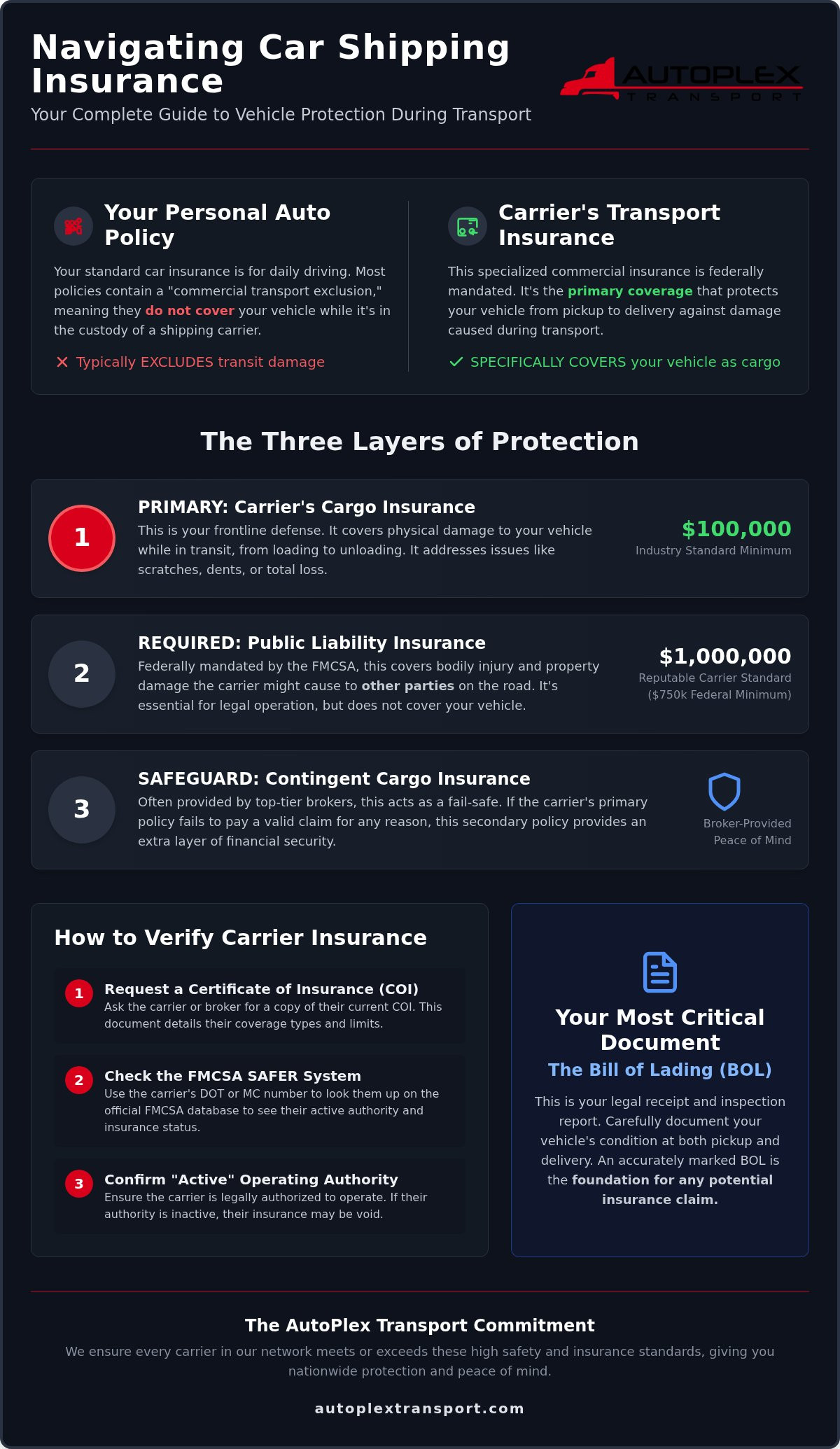
Many owners assume their existing policy provides enough protection, but the reality is more complex. While Understanding Vehicle Insurance is helpful for daily driving, those same rules often don’t apply when your car is on a commercial hauler. Most personal policies explicitly exclude damage that occurs during commercial transport. This creates a “gap” where your car is effectively unprotected if the carrier doesn’t have the right coverage. We recommend notifying your insurance provider before the pickup date to see if they offer a temporary rider. However, your personal policy usually acts only as a secondary layer. The carrier’s cargo insurance remains the primary source of recovery if damage occurs. Relying solely on your own insurance could lead to out-of-pocket expenses or increased premiums for an accident you didn’t cause. Understanding this distinction is the first step toward a worry-free transport experience.
Exploring Your Car Shipping Insurance Options: The Three Layers of Protection
When you evaluate car shipping insurance options, it’s helpful to view your protection as a methodical, three-layer safety net. This structure ensures that no matter what happens on the road, there’s a financial mechanism in place to make you whole. Understanding how these layers interact is the key to a stress-free move. By looking at the total picture, you can move from a state of uncertainty to a state of total confidence in your transport plan.
The first and most critical layer is the carrier’s cargo insurance. This is the primary policy that covers your vehicle while it’s physically on the trailer. For standard open carriers, $100,000 in cargo insurance is the industry baseline. If a carrier offers less, it’s a clear signal that they may not meet professional standards for nationwide transport. The second layer is liability insurance, which covers damages the truck might cause to other people or property. While liability is legally required, it doesn’t actually protect your car; that’s the specific job of the cargo policy.
The third layer is contingent cargo insurance. This is a safeguard often provided by top-tier brokers to act as a fail-safe. If a carrier’s insurance is unexpectedly cancelled or a claim is denied due to a technicality, the contingent policy provides an extra level of security. This ensures your investment is protected even in complex legal scenarios that might otherwise leave a vehicle owner vulnerable.
Cargo Insurance vs. Liability Insurance
Cargo insurance is the specific policy that pays for physical damage to your vehicle, such as scratches, dents, or a total loss. Liability insurance, conversely, protects against property damage or bodily injury caused by the transport truck itself. These two policies work in tandem. While liability covers the carrier’s operational risks, cargo insurance protects your specific asset. You can find more about your rights as a consumer through the FMCSA’s Protect Your Move program, which highlights how these requirements shield you from illegitimate operators.
Supplemental and Contingent Coverage
What happens if you’re shipping a classic or exotic vehicle? In these cases, standard limits might not be enough. Our Enclosed Car Transport: The Definitive Buying Guide for 2026 explains why specialized carriers often carry much higher cargo limits, often between $250,000 and $1,000,000. Choosing the right car shipping insurance options depends largely on your vehicle’s value and the level of risk you’re willing to accept. If you’re looking for a reliable partner to manage these complexities, consider our nationwide transportation services where every carrier is rigorously vetted for maximum coverage.
The Bill of Lading: Your Most Critical Insurance Document
While you have spent time researching car shipping insurance options, the actual success of a claim often rests on a single document: the Bill of Lading (BOL). This isn’t merely a receipt for your vehicle; it’s a legally binding contract and a detailed condition report that serves as the primary evidence in any insurance dispute. Insurance adjusters treat the BOL as the “source of truth” when determining whether damage occurred during transit or existed prior to pickup. If a scratch or dent is not documented on the BOL at the time of delivery, the carrier’s insurance company will almost certainly deny the claim, assuming the damage happened after the car left the driver’s care.
The Pre-Shipment Inspection Process
The foundation of a safe transport begins with a methodical walk-around. You and the driver must inspect every panel of the vehicle together, noting even the smallest chips or scratches on the BOL’s diagram. This is a critical step for all vehicles, but it is especially vital for high-value assets. This level of detail is a point often highlighted in a Forbes Advisor review of car shipping when discussing exotic or classic car protection. We recommend taking high-resolution, time-stamped photos and videos of the vehicle from all angles, including the roof and undercarriage, immediately before the driver loads the car. For a complete guide on getting your vehicle ready for this inspection, refer to our How to Prepare a Car for Transport: The 2026 Essential Checklist.
Filing a Claim Using the BOL
When your vehicle arrives, your first priority is a thorough delivery inspection. You should never sign the BOL until you have completed this final check, ideally in daylight or under bright lights. If you discover new damage, you must note it clearly on the BOL before the driver departs. This “Before and After” comparison is exactly what insurance adjusters use to determine fault and process payments. If a driver refuses to allow you to note damage, do not sign the document and contact your transport partner immediately. Most car shipping insurance options require claims to be initiated within 24 to 48 hours of delivery. Promptly providing the signed BOL alongside your time-stamped photos will significantly accelerate the resolution process. This disciplined approach ensures that the insurance layers you’ve secured actually work in your favor when they are needed most.
How to Evaluate and Verify Auto Transport Insurance Coverage
Securing the right protection starts with independent verification. You shouldn’t simply take a company’s word that they are covered. A professional approach involves a four-step vetting process to ensure your vehicle is protected by legitimate car shipping insurance options. First, request a Certificate of Insurance (COI) directly from the carrier or broker. This document lists the policy limits and the expiration date. A lapsed policy is a major red flag that indicates an operator is not maintaining their professional obligations.
Second, use the FMCSA SAFER website to perform an independent background check. By entering the carrier’s MC number, you can verify their safety rating and insurance status in real time. This step is vital because it bypasses any potentially falsified documents. Third, clarify the deductible. While many carriers cover the deductible themselves, some policies may pass a portion of that cost to you if a claim is filed. Finally, check for specific exclusions. Knowing exactly what isn’t covered is just as important as knowing what is.
Understanding Deductibles and Exclusions
Every commercial policy has a deductible, which typically ranges from $200 to $2,000. The industry average is approximately $500. You should confirm in writing whether the carrier will pay this amount in the event of damage. It’s also critical to understand that personal belongings left inside the vehicle are never covered by cargo insurance. If you leave a laptop or expensive tools in the trunk, you do so at your own risk. Additionally, 2026 has seen an industry shift toward stricter “Acts of Nature” clauses due to climate volatility. These clauses often exclude damage from hail, floods, or wind on open trailers. If you are shipping a high-value vehicle through a region prone to severe weather, enclosed transport provides a much more secure “insurance” against these environmental exclusions.
The Danger of Under-Insured Carriers
Quotes that seem too good to be true often come from carriers with minimal or lapsed coverage. These operators save money by carrying the bare FMCSA minimums, which may not fully cover a multi-car load if a major accident occurs. Red flags include a carrier’s refusal to provide a COI or an MC number that shows “inactive” authority on the SAFER website. Working with an experienced partner eliminates this risk. We provide nationwide transportation services that rely on a rigorous vetting process, ensuring every carrier in our network maintains high cargo insurance thresholds and active authority. This professional oversight means you don’t have to spend hours playing detective to ensure your vehicle is safe.
Nationwide Protection: The AutoPlex Transport Commitment
While understanding the various car shipping insurance options is vital, the practical application of that knowledge requires a partner with the right technology and industry experience. We act as your expert guide, handling the complex task of vetting insurance policies so you don’t have to. Our approach is grounded in the belief that transparency is the foundation of trust. We provide our clients with direct access to carrier information, ensuring you know exactly who is handling your vehicle and what protections are in place before the trailer even arrives at your door.
Our door to door transportation model is a key component of our safety strategy. By moving your vehicle directly from its origin to its destination, we significantly reduce the amount of handling involved. Every time a vehicle is moved between terminals or loaded onto a different trailer, the risk of a minor incident increases. Our streamlined process minimizes these touchpoints, which is the most effective way to ensure a clean Bill of Lading at the end of the journey. This methodical focus on safety allows us to maintain a high standard of care across all our nationwide routes.
Rigorous Carrier Vetting Standards
We utilize a sophisticated monitoring system to verify DOT authority and insurance active status for every shipment. This isn’t just a one-time check; we monitor our carriers to ensure their coverage hasn’t lapsed or been reduced. We only partner with operators who meet or exceed high cargo insurance thresholds, providing you with the three layers of protection we’ve detailed throughout this guide. Our history of safe delivery across the United States is a testament to these strict standards. For those looking for more detail on our standard shipping methods, The Comprehensive Guide to Open Transport Car Shipping in 2026 offers a deep dive into how we manage safety on the road.
Ready for a Secure Shipment?
Choosing a professional partner is the best insurance policy you can buy. It shifts the burden of technical verification from your shoulders to a team of seasoned logistics experts. We believe that you deserve a shipping experience free from the anxiety of hidden exclusions or under-insured carriers. When you work with us, you receive a comprehensive quote that includes full insurance details tailored to your specific vehicle and route. Contact our team for a transparent, insured shipping quote today and let us provide the professional protection your vehicle deserves.
Securing Your Vehicle for the Road Ahead
Protecting your vehicle during nationwide transport is a process of verification and methodical planning. You now understand that comprehensive coverage depends on more than just a carrier’s promise; it requires a combination of high-limit cargo insurance, a meticulous Bill of Lading, and the oversight of a professional logistics partner. By focusing on these essential layers, you can move forward with the confidence that your investment is shielded from pickup to delivery.
Navigating the various car shipping insurance options is much simpler when you work with a team that prioritizes transparency and safety. We are specialists in safe door-to-door delivery, utilizing a vetted nationwide carrier network and partnering with A+ rated cargo insurance providers to ensure every shipment meets our rigorous standards. We invite you to experience a transport process where your peace of mind is our primary objective. Our team is ready to handle the logistical details so you can focus on your next destination.
Get a Secure, Fully Insured Car Shipping Quote from AutoPlex Transport
Frequently Asked Questions
Is insurance included in my car shipping quote?
Yes, the cost of the carrier’s cargo and liability coverage is already included in your professional transport quote. You won’t be charged a separate premium for this mandatory protection. This coverage is a standard part of the car shipping insurance options that every legitimate carrier must provide to operate across state lines. If a company asks for an additional insurance fee after giving you a quote, treat it as a significant red flag.
What happens if my car is damaged during transport?
You must document any new damage on the Bill of Lading (BOL) before the driver leaves the delivery location. This documentation is the only way to initiate a valid insurance claim. Once the damage is noted, you should contact the carrier or broker immediately to start the process. You’ll need to provide your pre-trip photos and the signed BOL to the insurance adjuster to prove when the damage occurred.
Does my personal car insurance cover the vehicle while it is on a trailer?
Most personal auto policies don’t cover your vehicle while it’s being moved by a commercial hauler. While some comprehensive plans might offer secondary coverage, they usually exclude damage that happens during professional transport. You should call your insurance agent to ask about a temporary rider. However, the carrier’s commercial cargo policy is always the primary source of protection for your vehicle during its cross-country journey.
What is the standard cargo insurance limit for car shippers?
The industry standard for cargo insurance is $100,000 for open carriers and up to $1,000,000 for enclosed trailers. While the FMCSA technically allows limits as low as $5,000, reputable companies maintain much higher thresholds. These car shipping insurance options ensure that even high-value vehicles are fully protected. We only partner with carriers who meet these professional standards to provide our customers with a high level of financial security.
Can I ship personal items in my car, and are they insured?
You can typically leave up to 100 pounds of soft goods in the trunk, but these items are never covered by the carrier’s insurance. Cargo insurance is strictly for the vehicle itself. If personal belongings are lost, stolen, or damaged during transit, the carrier isn’t liable for the loss. We strongly recommend removing all electronics, valuables, and household items before your vehicle is loaded onto the trailer for transport.
What is a Bill of Lading, and why is it important for insurance?
The Bill of Lading is the official legal contract and condition report that tracks your vehicle from pickup to delivery. It’s the most important document for insurance because it records every existing scratch or dent before the trip begins. If you find new damage at delivery, it must be written on this document. Insurance adjusters rely on the BOL as the primary evidence to determine if a claim is valid.
How do I verify if an auto transport company is actually insured?
You can verify a company’s insurance by requesting their Certificate of Insurance (COI) and checking their Motor Carrier (MC) number. Use the FMCSA SAFER website to look up the MC number and confirm their insurance status is active. This independent check is the best way to ensure the company has the legal authority and financial backing to transport your vehicle safely across the country without any hidden risks.
Does enclosed car transport offer better insurance coverage than open transport?
Enclosed transport provides superior insurance because it usually includes higher cargo limits and protects against weather-related exclusions. Many open carrier policies have “Acts of Nature” clauses that exclude damage from hail or wind. Enclosed carriers often have limits ranging from $250,000 to $1,000,000. This makes it the preferred choice for classic or exotic vehicles that require the highest level of physical and financial protection during transit.