Last June, a vehicle owner preparing for an interstate move watched their car pull away on a transport trailer, only to spend the next three days worrying about potential road hazards and whether the driver would communicate clearly. It’s a common anxiety for anyone coordinating car shipping from Houston to Florida, especially when faced with the risk of hidden fuel surcharges or shifting delivery dates. You deserve a process that prioritizes the safety of your vehicle and the clarity of your schedule, a standard upheld by AutoPlex Transport Company.
This article will help you master the logistics of this popular interstate route with a professional breakdown of costs, carrier types, and a real-world transit case study. We’ll preview how recent 2026 regulatory shifts, like the FMCSA’s transition to USDOT numbers as primary identifiers and stricter English proficiency enforcement, impact your shipment. By the end of this guide, you’ll have the knowledge needed to secure transparent pricing and a damage-free delivery for your interstate move. We will explore everything from open carrier options to the benefits of enclosed transport for high-value assets.
Key Takeaways
- Understand the transit dynamics of the I-10 corridor, including why most journeys require a three to five day window to navigate the 1,100 miles safely.
- Learn how to balance budget and protection by choosing between the industry standard open carrier or the enhanced safety of enclosed transport.
- Review a real world case study of a luxury SUV move to see how professional car shipping from Houston to Florida handles everything from safety vetting to final delivery.
- Master the preparation checklist, focusing on the critical role of exterior cleaning and the legal restrictions regarding personal items in the trunk.
- Identify the key indicators of a trustworthy carrier, such as upfront logistics costs and a proven history of nationwide service.
The I-10 Corridor: Navigating Car Shipping from Houston to Florida
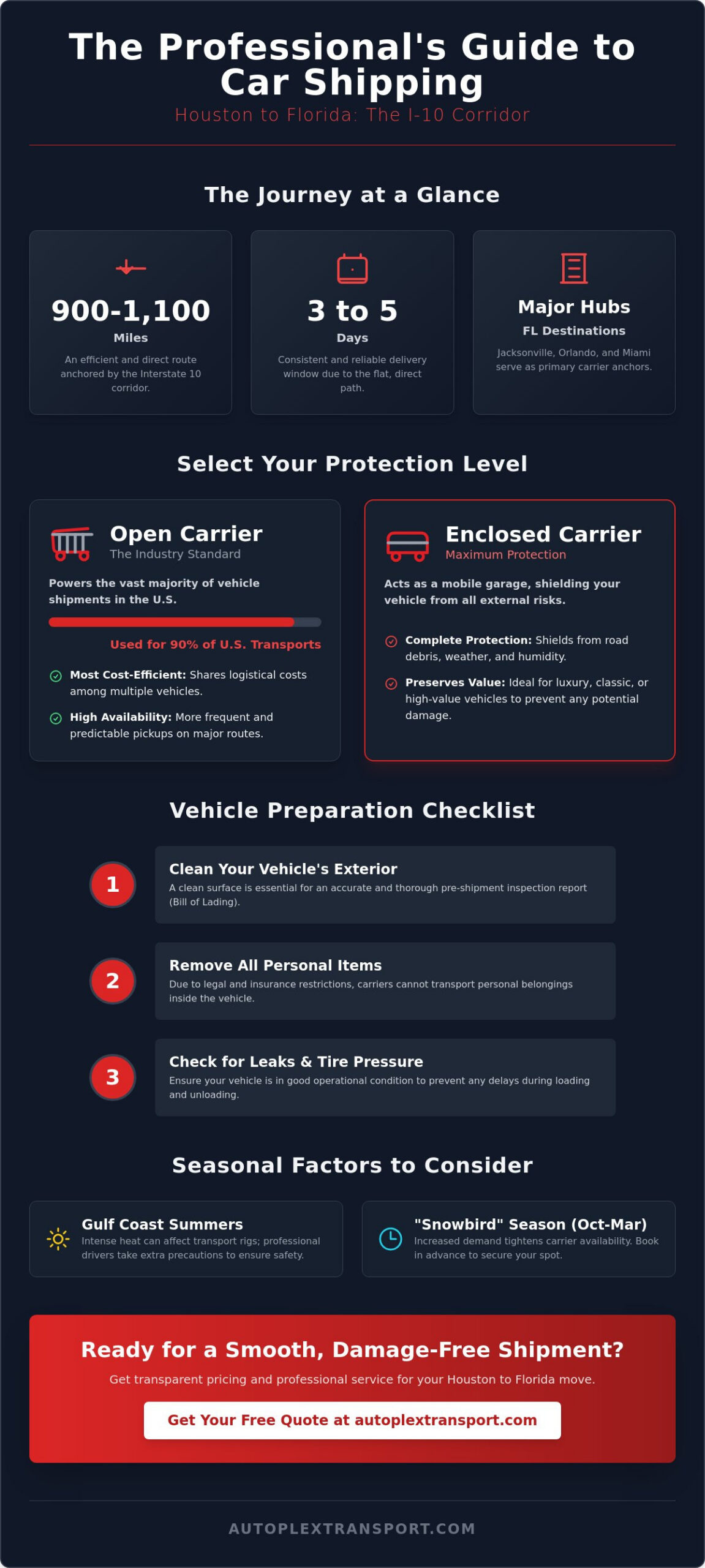
The logistics of car shipping from Houston to Florida revolve almost entirely around a single, massive artery of commerce. Spanning approximately 900 to 1,100 miles depending on your specific destination in the Sunshine State, this route is anchored by the Interstate 10 corridor. It’s widely considered one of the most efficient shipping lanes in the United States because it lacks the extreme mountain passes found in the West or the heavy snow delays common in the North. Most transit times range from 3 to 5 days. This timeframe remains consistent because the path is relatively flat and direct. Major hubs like Jacksonville, Orlando, and Miami serve as the primary anchors for carrier planning. Drivers often group multiple vehicles destined for these cities to maximize their efficiency, which helps maintain a steady flow of traffic between Texas and the East Coast.
Route Density and Transit Efficiency
High volume lanes between Texas and Florida are a significant benefit for the consumer. Because so many vehicles travel this path, pickups are more frequent and predictable than on remote rural routes. Most carriers prefer these “hot lanes” because they minimize empty miles and keep equipment moving. For those moving to smaller Florida panhandle towns or rural communities, carriers often utilize a hub-and-spoke model. This means your vehicle might arrive at a major Florida terminal before a local driver completes the final leg of the journey via door 2 door transportation. Choosing professional interstate vehicle transportation provides an extra layer of security for these long distance southern hauls. Experienced nationwide providers have the infrastructure to manage these complex logistics without compromising the safety of your asset.
Seasonal Impacts on Southern Transit
Managing logistics in the South requires a keen understanding of the seasonal calendar. Gulf Coast hurricane season and intense summer heat can occasionally impact transit schedules. High temperatures can affect tire pressure and cooling systems on transport rigs, requiring drivers to take extra precautions during the hottest months. Additionally, the “Snowbird” migration significantly impacts carrier availability. Between October and March, thousands of seasonal residents move toward Florida, which tightens the market. This seasonal surge can limit availability and affect lead times if you don’t book in advance. Professional logistics planning is essential for anyone managing a time sensitive relocation during these peak windows. It ensures your vehicle doesn’t get sidelined by predictable market shifts or regional weather events.
Selecting the Right Service: Open vs. Enclosed for Southern Routes
Choosing the right equipment for car shipping from Houston to Florida is a decision that balances your budget with your tolerance for risk. A 1,000-mile journey across the South involves more than just highway miles. It’s an exposure to high-speed road debris, fluctuating humidity, and unpredictable weather patterns. Understanding the cost-to-protection ratio is the first step in ensuring your vehicle arrives in the same condition it left your driveway. While most cars handle the trip perfectly on a standard trailer, certain vehicles benefit from an extra layer of security.
Benefits of Open Carrier Car Transportation
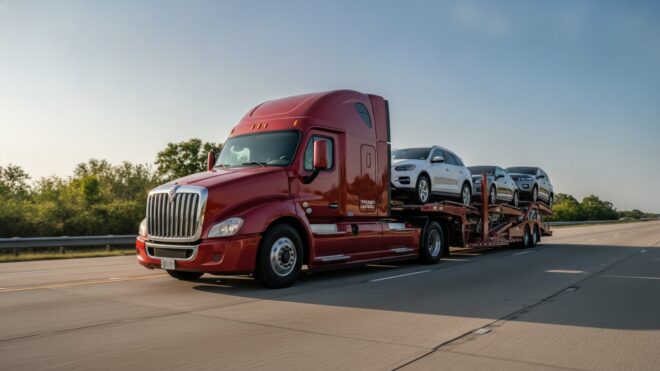
open transport car shipping remains the most popular choice for a reason. It’s the engine that drives nearly 90% of the U.S. transport market. By utilizing multi-car trailers, you’re able to share the logistical costs with other customers, making it the most cost-efficient method available. Visibility is a key advantage here. Because the vehicles are out in the open, drivers can easily spot any issues during their routine inspections at rest stops. It’s a reliable, transparent way to move standard sedans and trucks without unnecessary expense, providing a steady balance of speed and value. For a deeper look at how this method works and what safety protocols are involved, our ultimate guide to open auto transport covers the engineering standards and logistics framework behind this industry-standard service.
When to Choose Enclosed Car Transport
There’s a common misconception that enclosed car transport is reserved exclusively for six-figure supercars. In reality, many owners choose this service to maintain the long-term resale value of their daily drivers when arranging car shipping from Houston to Florida. A hard-sided trailer acts as a mobile vault, protecting the finish from the abrasive road grime and salt air found as you approach the Atlantic coast. If your car has low clearance, these carriers use hydraulic lift gates to ensure a level loading process. This specialized equipment prevents the undercarriage damage that can occur on traditional ramps, making it the gold standard for any vehicle you wish to keep in pristine condition.
Regardless of the carrier type you select, your priority should always be safety and legitimacy. We encourage every customer to consult the consumer protection guidelines to understand their rights during an interstate move. This ensures you’re working with a company that respects federal regulations and prioritizes the security of your asset. If you’re ready to explore your options for Interstate Vehicle Transportation, our team is here to guide you through the selection process with clear communication and professional care.
Case Study: Moving a High-Value Vehicle from Houston to Florida
To truly understand the mechanics of car shipping from Houston to Florida, it’s helpful to examine a real-world scenario. Imagine a customer relocating a 2024 luxury SUV from a quiet residential street in Houston to a bustling suburb of Miami. This 1,000-mile journey requires more than just a driver and a trailer. It demands a meticulous approach to logistics that begins long before the vehicle is ever loaded. By following expert car shipping tips, the customer ensured they were prepared for the documentation and inspection phases required for a high-value move.
Rigorous Carrier Vetting for Interstate Safety
Safety is not a generic promise; it’s a data-driven metric. Before assigning a carrier for this specific SUV, we analyzed the hauler’s safety record through the Federal Motor Carrier Safety Administration (FMCSA) database. This process involves checking the 5-point safety rating, which monitors crash history and inspection compliance. We also verify that the cargo insurance limits are sufficient to cover the full replacement value of a 2024 luxury vehicle. AutoPlex only works with carriers who maintain a 98% or higher safety rating. This strict standard ensures that only the most reliable professionals handle your property during interstate vehicle transportation.
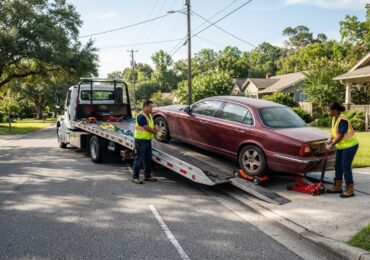
The loading process for this case study took place directly at the customer’s Houston residence. Door 2 door transportation allows for a convenient handover, but it requires a skilled driver to navigate residential streets with a large multi-car trailer. The driver performed a comprehensive initial inspection, noting every detail of the vehicle’s condition on the Bill of Lading (BOL). Once the vehicle was secured, the SUV began its transit across the Gulf Coast states. This initial precision is what prevents disputes later in the process.
Communication is the bridge that builds trust during a long haul. Throughout the journey, the customer received real-time tracking milestones. These updates confirmed the vehicle’s progress as it passed through Louisiana, Mississippi, and Alabama. Knowing exactly where the car is located provides peace of mind that vague delivery windows simply cannot offer. It transforms the shipping experience from a period of uncertainty into a managed logistical event.
Successful Delivery and Final Inspection
Delivering a vehicle in a high-density Florida neighborhood presents its own set of challenges. The driver coordinated with the customer to find a safe, accessible spot for off-loading that wouldn’t obstruct local traffic. Once the SUV was on the ground, a final inspection was performed. The customer compared the vehicle’s current state against the original BOL documentation to confirm a damage-free arrival. A seamless delivery is the ultimate hallmark of a professional car shipping company. It proves that every step of the car shipping from Houston to Florida process, from vetting to the final mile, was executed with precision.
Interstate Preparation Checklist: Securing Your Vehicle
Preparing your vehicle for car shipping from Houston to Florida requires more than just a quick walkthrough. It involves a systematic approach to ensure both safety and legal compliance during the 1,000-mile transit. While the carrier handles the heavy lifting, your role in the preparation phase is critical for a smooth handover and a successful delivery in the Sunshine State. Taking the time to follow a structured checklist provides the peace of mind that your asset is ready for the road.
One of the most overlooked steps is a thorough exterior cleaning. It might seem counterintuitive to wash a car before it spends days on a highway, but a clean surface is the only way to perform an accurate pre-shipment condition report. Dirt and road grime can easily mask small chips, dings, or scratches. When the driver arrives, you’ll both inspect the vehicle together. Having a clean exterior ensures every existing mark is documented correctly, which is essential for your protection.
Regarding personal items, the industry standard for 2026 allows for up to 100 lbs of belongings to be stored in the trunk of the vehicle, provided they remain below the window line. However, it’s vital to remember that these items are not covered by the carrier’s cargo insurance. Carriers are legally prohibited from hauling household goods because they’re licensed for vehicle transport only. To minimize risk, we recommend removing all valuables and keeping the interior as empty as possible to prevent any interior damage during movement.
Documenting Vehicle Condition
Take high-resolution photos of every angle, including the roof and the lower bumpers, right before the carrier arrives. These time-stamped images serve as your secondary record. During the loading process, you’ll review the Bill of Lading (BOL). The Bill of Lading is the industry-standard legal contract between the owner and the carrier. Properly noting every existing scratch on this document before the driver leaves your driveway ensures you have full legal protection if a discrepancy arises at the delivery point in Florida.
Operational Readiness for the Trailer
Your vehicle must be in good working order to be safely loaded onto the trailer. This means the steering, braking, and rolling mechanisms must function perfectly. We recommend keeping your fuel level at approximately 1/4 tank. This provides enough fuel for the driver to move the vehicle on and off the trailer while minimizing the overall weight of the shipment. Additionally, remember to disable all toll tags and alarm systems. The vibrations of the trailer can trigger alarms, leading to a dead battery, while toll sensors may inadvertently charge your account as the truck passes through gantries. For a comprehensive look at our Interstate Vehicle Transportation services, contact our specialists to discuss your specific preparation needs.
Why AutoPlex is the Best Car Shipping Company for Interstate Routes
When you choose a partner for car shipping from Houston to Florida, you aren’t just buying a spot on a trailer. You’re investing in a logistics framework designed to protect your vehicle across 1,000 miles of southern highway. At AutoPlex Transport Company, we position ourselves as a reliable partner rather than a distant corporation. Our nationwide transportation services reach all 50 states, yet we maintain a specialized focus on the high-volume lanes connecting Texas to the Atlantic coast. This local expertise allows us to navigate the specific challenges of the I-10 corridor with precision and care.
Transparency is the foundation of our business model. We understand the frustration of hidden fuel surcharges or vague delivery windows that shift after you’ve already booked. That’s why we provide upfront logistics costs that don’t change. We maintain a vetted network of car shippers who meet our rigorous standards for insurance and safety performance. As we highlighted in our case study, we only collaborate with carriers who hold a 98% or higher safety rating. This commitment to quality ensures that your vehicle is in the hands of seasoned industry veterans who value your property as much as you do.
Our Door 2 Door transportation model prioritizes both your convenience and your vehicle’s security. By managing the process from your driveway in Houston to your new residence in Florida, we eliminate the risks associated with third-party terminals or storage facilities. This direct approach reduces the number of times your vehicle is handled, which is the most effective way to ensure a damage-free delivery. We handle the complex coordination so you can focus on the other aspects of your relocation.
A Professional Approach to Auto Logistics
Our “Reliable Partner” philosophy means we prioritize education and transparency at every stage of the journey. We believe a well-informed customer is a confident one. To support this, we include comprehensive cargo insurance with every interstate shipment we manage. You won’t have to worry about the fine print of carrier policies because we’ve already done the vetting for you. Our 24/7 support provides you with direct access to logistics experts who understand the Southern corridor and can provide real-time updates whenever you need them.
Requesting Your Professional Shipping Quote
Getting an accurate estimate for car shipping from Houston to Florida requires a detailed look at your specific needs. We factor in your vehicle type, the total distance, and your preference for open or enclosed carrier services to build a realistic logistics plan. It’s important to understand the difference between a “budget” quote and a reliable service. A low-ball estimate often leads to delays or hidden fees, whereas a professional plan ensures your vehicle is picked up and delivered on schedule by a qualified driver.
Get your professional car shipping quote from AutoPlex Transport Company today!
Securing Your Interstate Move with Confidence
Moving your vehicle along the southern corridor doesn’t have to be a source of stress. By understanding the logistics of the I-10 route and choosing the right service level for your specific needs, you’ve already mitigated the most common risks. The key to a successful experience always lies in the details. This includes rigorous carrier vetting and precise documentation on your Bill of Lading to ensure full legal protection. When you prioritize a professional approach to car shipping from Houston to Florida, you ensure your vehicle arrives safely and on schedule.
AutoPlex is here to serve as your reliable partner throughout this entire process. We provide A+ Rated Logistics Support and maintain a Fully Vetted Nationwide Carrier Network to handle every mile with care. With Comprehensive Cargo Insurance Included in every shipment, you can rest easy knowing your asset is protected from the moment it leaves Houston. We’re committed to transparency and clear communication from pickup to delivery.
Get an Instant Quote for Your Houston to Florida Shipment
We look forward to helping you complete your interstate journey with the professional expertise and security your vehicle deserves.
Frequently Asked Questions
How much does it cost to ship a car from Houston to Florida?
The total cost depends on several variables including the size of your vehicle, the time of year, and whether you choose open or enclosed transport. For instance, shipping during the peak “Snowbird” season typically commands higher rates due to increased demand. We recommend requesting a personalized estimate to ensure you receive a transparent price that reflects your specific logistics requirements and delivery timeline.
How long is the transit time between Houston and Florida?
Most shipments between Houston and Florida are completed within a three to five day window. This timeframe accounts for the 1,000-mile distance and the federal regulations governing driver hours of service. While the I-10 corridor is a highly efficient route, factors such as traffic density in major hubs like Jacksonville or Miami can occasionally influence the exact arrival time at your destination.
Is my car insured during the interstate transport process?
All professional interstate vehicle transportation includes cargo insurance to protect your asset against transit-related damage. AutoPlex maintains a rigorous vetting process to ensure that every carrier in our network carries sufficient coverage for the full value of the vehicles they haul. It’s always a good practice to review the specific insurance limits and terms before your vehicle is loaded onto the trailer.
Can I ship personal belongings inside my vehicle?
Industry standards allow for a small amount of personal property, usually up to 100 lbs, to be stored in the trunk. However, these items are not covered by the carrier’s cargo insurance policy and are shipped at the owner’s risk. Federal regulations prohibit auto transporters from acting as household movers, so it’s best to keep the interior of the car empty to ensure safe handling.
What is the difference between open and enclosed transport for this route?
When arranging car shipping from Houston to Florida, you must decide between cost-efficiency and maximum protection. Open transport is the most common method and is ideal for standard daily drivers. If you want to understand the full scope of how open auto transport works, including its safety protocols and regulatory standards, our detailed guide provides everything you need to make a confident decision. Enclosed transport is a premium service that shields high-value or luxury vehicles from road debris and weather. This choice often depends on your vehicle’s value and your personal preference for maintaining its exterior finish.
Do I need to be present for the pickup and delivery of my car?
Either the owner or an authorized adult must be available during the pickup and delivery phases. This presence is necessary to perform the joint physical inspection with the driver and to sign the Bill of Lading. This document is your primary legal protection, as it records the vehicle’s condition at the start and end of the interstate journey to ensure accountability.
What documents do I need to ship my car to Florida?
Shipping a vehicle within the United States is a straightforward process regarding paperwork. You will need to provide your driver’s license and a copy of your current insurance policy. The most critical document is the Bill of Lading, which the driver provides at the time of pickup. If you’re moving to Florida permanently, remember you’ll need your title and registration to register the car locally within 10 days.
What happens if my car is damaged during shipping?
If you notice damage upon delivery, you must document it immediately on the Bill of Lading before the driver leaves. The delivery report serves as your official record of condition. If you find a new scratch or dent, note it clearly and take high-resolution photos. You should then contact the transport company to initiate an insurance claim. Having clear documentation is the most effective way to ensure a swift and fair resolution.