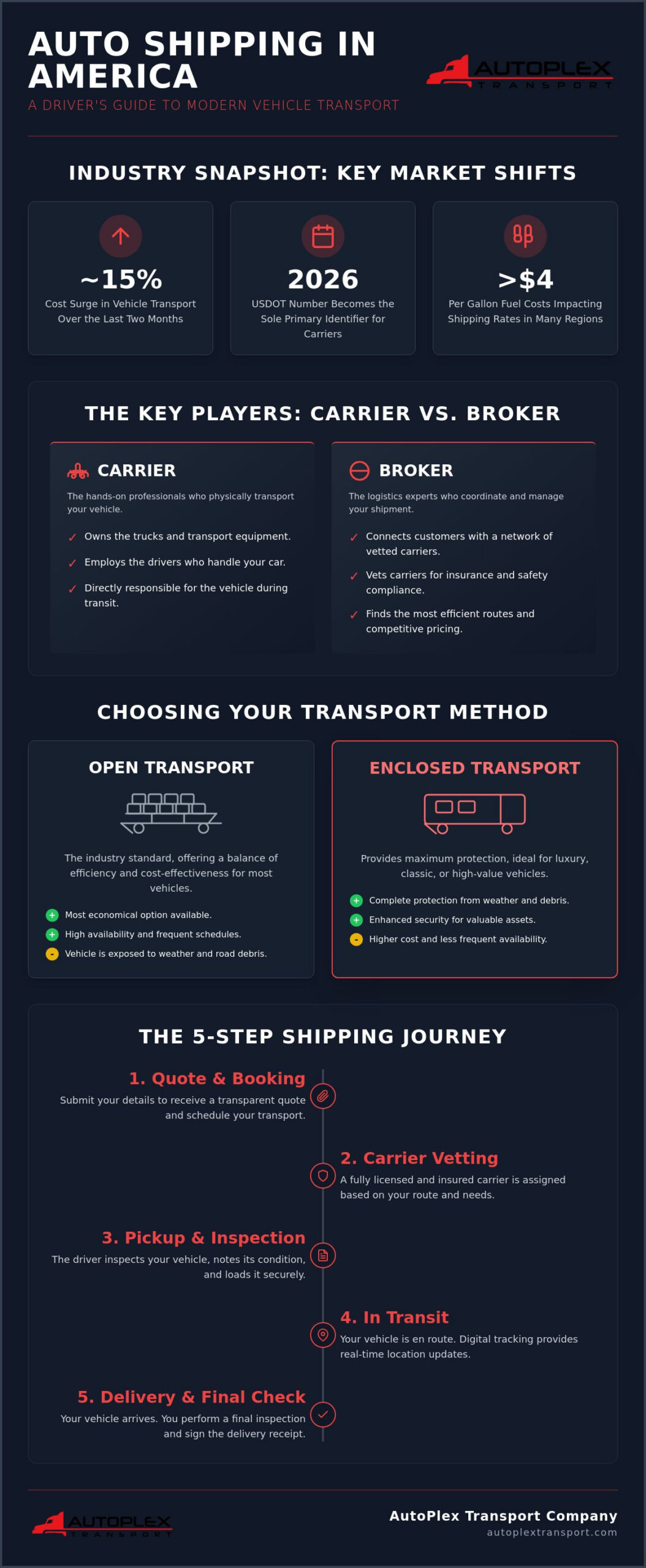
Did you know that the average cost of vehicle transport surged by nearly 15 percent in just the last two months? This sudden volatility, paired with the 2026 transition to USDOT numbers as the sole primary identifier for carriers, has made understanding auto shipping america more complex than ever. You’re likely concerned about the safety of your car during a long-distance move and frustrated by the lack of transparency in national quotes. It’s a common worry, especially when hidden fees can often lurk behind a low initial price.
This guide serves as your comprehensive resource, offering the technical knowledge needed to protect your investment. We’ll clarify the essential distinctions between brokers and carriers while explaining how new 2026 financial standards for brokers impact your service. By the end of this article, you’ll understand the logistics of interstate transport, how to verify a company’s legal standing, and whether open or enclosed shipping fits your specific needs. We’ve organized this information to lead you from initial inquiry to a confident, informed decision.
Key Takeaways
- Learn how major arterial highway networks and hub-and-spoke logistics dictate the speed and efficiency of long-distance vehicle transit.
- Identify the core differences between open and enclosed transport to determine which equipment standard best protects your vehicle’s value.
- Understand the vital role of the FMCSA and how to use DOT numbers to verify the legitimacy of any interstate carrier.
- Discover how a safety-first vetting framework for auto shipping america helps eliminate the risks associated with unverified providers.
- Gain a clear roadmap of the shipping process, from initial logistical planning to the final delivery at your destination.
The Landscape of Auto Shipping in America
Nationwide auto shipping is the specialized movement of vehicles via multi-car carriers across state lines. In the United States, this involves managing a vast network of arterial routes that span the continental landscape. It’s a logistical science that requires precise coordination of schedules, equipment, and safety regulations. While some owners consider driving their own vehicles long distances, professional auto shipping america services offer a safer and often more economical alternative. When you factor in the cost of fuel, which has recently exceeded $4 per gallon in several regions, along with hotel stays and vehicle depreciation, the value of professional transport becomes clear.
Logistics providers act as the central nervous system for these operations. They coordinate complex multi-vehicle schedules to ensure that trailers are filled efficiently, which helps manage costs for the end consumer. This level of coordination is what allows for reliable door-to-door or terminal-to-terminal service across thousands of miles. By consolidating multiple vehicles onto a single trailer, providers reduce the carbon footprint and the total cost per unit compared to individual transit.
This efficiency is particularly beneficial for those purchasing vehicles through global platforms. To see how a modern marketplace facilitates these transactions, learn more about AutoDream and their network connecting buyers and sellers across 15 countries.
The Evolution of National Vehicle Logistics
The industry has transitioned from simple local towing to a sophisticated interstate network. By 2026, digital tracking and GPS integration have become the standard, providing customers with real-time updates on their vehicle’s location. This transparency builds trust and reduces the anxiety often associated with long-distance transit. Also, the implementation of Electronic Logging Devices (ELDs) has standardized delivery timelines. While these regulations ensure driver safety by monitoring hours of service, they also create more predictable arrival windows for customers. Modern equipment, such as the specialized Car Carrier Trailer, has also improved fuel efficiency, helping carriers mitigate some of the rising operational costs seen in the current market.
Key Industry Stakeholders: Carriers vs. Brokers
Understanding the difference between a carrier and a broker is essential for any vehicle owner. A carrier is the physical company that owns the trucks, employs the drivers, and maintains the equipment. They’re the ones who will actually handle your car. A broker, on the other hand, acts as a logistical coordinator. They use their network to connect customers with verified, high-quality carriers. Brokers play a vital role in auto shipping america because they have the resources to vet carriers for insurance compliance and safety ratings. Many people find that a hybrid approach offers the best balance of reliability and price. Brokers have the bird’s-eye view of the market, allowing them to find available space on a carrier’s route that an individual might never discover on their own. This partnership ensures that vehicle transport remains accessible while maintaining the high safety standards required for interstate transport.
Understanding Carrier Types and Specialized Equipment
The physical infrastructure of auto shipping america relies on specialized engineering designed to keep vehicles stationary during thousands of miles of travel. This process isn’t as simple as driving a car onto a flatbed. It involves a sophisticated understanding of weight distribution and securement technology. Multi-car haulers utilize complex hydraulic ramps to maximize space while adhering to strict federal weight limits. Most carriers must stay under the 80,000-pound gross vehicle weight limit, which dictates how many heavy SUVs versus compact cars a single trailer can accommodate at one time.
To secure these assets, modern fleets have moved away from metal chains in favor of soft-tie down systems. These high-strength nylon straps wrap over the tires, which allows the vehicle’s own suspension to absorb road vibrations without putting unnecessary stress on the chassis or frame. This methodical approach to securement is a hallmark of professional transport standards in 2026.
Open Carrier Logistics: The Backbone of American Shipping
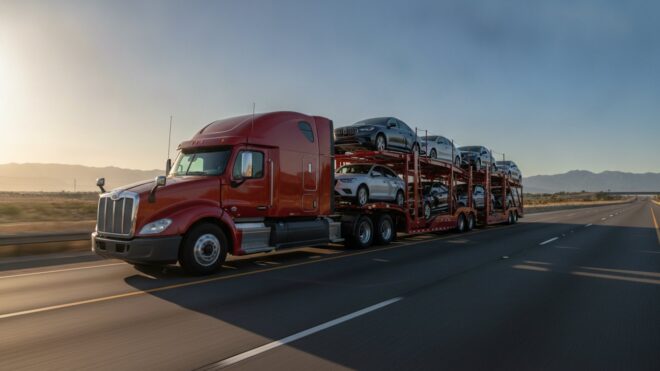
Standard open trailers typically carry 7 to 10 vehicles across two levels. This configuration is the primary driver of efficiency in the industry, making it the standard choice for daily drivers. Owners often worry about fluid leaks from cars on the upper deck or road debris impact. However, professional loading protocols require specific staggering and the use of drip guards to prevent cross-contamination between vehicles. For a deeper look at these mechanics and safety features, you can read The Comprehensive Guide to Open Transport Car Shipping in 2026. These trailers are built to withstand the elements while providing a reliable, cost-effective solution for most relocation needs. If budget is a primary concern, understanding why open transport is also the cheapest way to ship a car cross country can help you make a confident, informed choice.
Enclosed Carriers: Climate and Debris Protection
For high-value assets, enclosed transport offers a sanctuary from road salt, weather, and prying eyes. You’ll generally choose between soft-side trailers, which use heavy-duty vinyl curtains, and hard-side trailers, which feature solid aluminum or composite walls. Hard-side units offer the highest level of security and climate protection. Many of these trailers utilize hydraulic lift-gates rather than traditional ramps. This technology is crucial for exotic cars with extremely low ground clearance, as it keeps the vehicle perfectly level during the loading process. You can explore these specialized options in Enclosed Car Transport: The Definitive Buying Guide for 2026. Regardless of the trailer type, all equipment must meet current FMCSA Regulations to ensure safety on public highways.
Choosing the right equipment is a balance of value and protection. If you’re unsure which trailer configuration suits your specific itinerary, the team at AutoPlex Transport can provide a personalized assessment based on your vehicle’s specifications.
Regulatory Standards and the Safety Framework
The Federal Motor Carrier Safety Administration (FMCSA) serves as the primary governing body for the vehicle transport industry. Its mission centers on reducing crashes, injuries, and fatalities involving large trucks and buses. When you’re researching auto shipping america, the FMCSA’s oversight provides the legal framework that keeps your vehicle safe. Every carrier authorized to move vehicles across state lines must maintain an active Department of Transportation (DOT) number. This identifier is more than just a registration code; it’s a gateway to the company’s entire safety and compliance history. In 2026, the industry has transitioned to using the DOT number as the sole primary identifier, which has streamlined the process for consumers to verify a company’s credentials.
Legal carriers must also carry specific insurance types. Liability insurance protects the public if the carrier’s equipment causes an accident. Cargo insurance, however, is what protects your specific vehicle while it’s in transit. You should always ask for a copy of the carrier’s insurance certificate to verify that their cargo limits are high enough to cover the full value of your car. If a company hesitates to provide this documentation, it’s a clear sign they may not be operating within federal guidelines.
The Bill of Lading (BOL) stands as the most critical document in the entire process. It’s a legally binding contract between the shipper and the carrier that functions as both a receipt and an inspection report. This document details the terms of the transport and the exact condition of the vehicle at the point of exchange. Without a properly executed BOL, resolving a damage claim becomes nearly impossible. It’s your primary evidence in any dispute, so you must ensure every detail is accurate before signing.
Verifying Carrier Authority and Safety Ratings
You can independently verify a company’s legitimacy using the FMCSA’s Safety and Fitness Electronic Records (SAFER) system. This public database allows you to check a carrier’s “Active Authority,” which confirms they’re legally allowed to operate as an interstate transporter. If a company lacks a DOT number or shows an “inactive” status, these are immediate red flags. You should also look for adequate insurance filings within the system. A carrier with a history of safety violations or frequent insurance lapses isn’t a reliable partner for your transport needs. Taking ten minutes to check these records can save you from the stress of dealing with an unverified provider.
The Inspection Process: Protecting Your Asset
The inspection process is your primary defense against transit-related disputes. In 2026, the industry standard has shifted toward comprehensive digital documentation. During pickup, the driver will perform a pre-trip inspection, marking any existing scratches, dents, or chips on the BOL. You should participate in this process by taking your own high-resolution photos of the vehicle from every angle. This digital trail provides objective proof of the car’s condition before it enters the auto shipping america network. To ensure you don’t miss a single step, follow How to Prepare a Car for Transport: The Ultimate 2026 Checklist. This preparation ensures that the delivery inspection is a simple matter of verification rather than a source of stress.
Logistics of Cross-Country Transport Routes
The movement of vehicles across the continent follows a structured national logistics grid. While it might seem like a direct point-A-to-point-B journey, auto shipping america actually relies on major arterial highway networks. Routes like I-95 on the East Coast, I-10 in the South, and I-80 through the Central U.S. serve as the primary corridors for multi-car carriers. These highways dictate both the speed and the cost of transport. If your vehicle is located near one of these high-traffic arteries, your pickup and delivery are likely to be more efficient than a shipment requiring a detour into remote regions.
Carriers utilize hub-and-spoke logistics to maximize trailer capacity. Shipping between major metropolitan hubs like Los Angeles, Dallas, or Atlanta is significantly more efficient because these cities act as consolidation points. When a carrier can fill a ten-car trailer in a single city, they reduce operational costs. Conversely, “deadhead” miles, which is the distance a carrier must travel empty to reach your vehicle, can increase your wait time. If a carrier is fifty miles away from your location, they’re more likely to prioritize your pickup than if they have to travel two hundred miles out of their way. Understanding these dynamics is key to finding the most cost-effective strategy for shipping a car cross country, since flexible pickup locations near major hubs can meaningfully reduce your total rate.
Seasonal migration patterns, particularly the “Snowbird” season between October and April, drastically shift national capacity. During these months, demand for routes heading toward Florida, Arizona, and Texas spikes. This surge in volume can limit availability for other regions, making it essential to plan your itinerary in advance to account for these shifts in carrier availability. If you’re planning a move along one of these high-demand southern corridors, our detailed guide on car shipping from Texas to Florida covers the specific timelines, carrier options, and 2026 regulatory requirements for that route.
Calculating Timelines for Long-Distance Shipping
Transit times generally scale with distance. A 500-mile journey typically takes 1 to 3 days, while a 1,500-mile trip might require 4 to 7 days. For cross-country hauls exceeding 2,500 miles, you should expect a timeline of 7 to 10 days. These estimates account for federal Hours-of-Service (HOS) regulations, which limit how many hours a driver can remain behind the wheel to ensure safety. You must also distinguish between the “pickup window,” which is the timeframe for the truck to arrive at your door, and the “delivery window,” which is the estimated arrival at the destination.
Regional Logistics Nuances
Geographic challenges vary by region. East Coast shipments often face heavy traffic congestion and restricted parkways, while West Coast routes must navigate mountain passes that are subject to sudden winter closures. Rural areas present a different challenge. Large multi-car haulers often cannot navigate narrow residential streets or low-hanging trees. In these cases, nationwide providers coordinate a meeting at a nearby large parking lot to ensure a safe transfer. If you’re planning a move to a remote area, you can request a custom logistics plan from our team to address these specific accessibility concerns.
Navigating the Shipping Process with AutoPlex Transport
Moving a vehicle across the country involves more than just finding an available trailer; it requires a partner who understands the intricate layers of the national infrastructure. AutoPlex Transport simplifies the logistics of auto shipping america by acting as your dedicated coordinator throughout the entire journey. We recognize that your vehicle is a significant asset. Our primary goal is to provide a sense of security by managing the technical details that often cause stress for individual owners. We take the burden of logistics off your shoulders, allowing you to focus on the other aspects of your relocation.
Our commitment to safety begins with a rigorous vetting framework. We don’t just find any available driver. Instead, we verify every carrier’s safety ratings, insurance standing, and historical performance before they’re ever assigned to your order. This proactive approach ensures that your car is in the hands of a seasoned professional who adheres to the highest industry standards. Throughout the interstate transit, we maintain transparent communication. You’ll receive real-time updates so you’re never left wondering about the status of your shipment. This steady flow of information is designed to build trust and ensure you feel supported from the initial quote to the final delivery. For companies looking to build similar trust through their own online presence, visit Fireheart Digital to explore specialized marketing strategies.
From Quote to Delivery: The AutoPlex Method
We’ve refined our process into three methodical steps to ensure a predictable and professional experience:
- Step 1: Precise Information Gathering. We start by collecting detailed vehicle specifications and your preferred timeline. This allows us to build a logistical plan tailored to your specific itinerary, ensuring no detail is overlooked.
- Step 2: Optimal Matching. We match your vehicle with the carrier type that provides the best protection, whether that’s an open hauler or an enclosed trailer, while optimizing the route for maximum efficiency.
- Step 3: Professional Coordination. Our team manages the pickup and final delivery logistics, including any necessary adjustments for residential accessibility or metropolitan traffic patterns discussed earlier in this guide.
Why National Experience Matters
The complexities of interstate regulations and the shifting 2026 landscape of auto shipping america require a deep level of expertise. We handle the paperwork and compliance hurdles so you don’t have to. Whether you’re moving a daily driver, a classic collector car, or a high-performance exotic, our experience across all major national routes ensures that we can handle any scenario with practicality and care. This seasoned perspective is what allows us to offer peace of mind to our clients every day. We’ve navigated the challenges of every major highway and metropolitan hub, making us a stable hand in a complex industry.
If you’re ready to secure a reliable partner for your next move, request your custom nationwide shipping plan from AutoPlex Transport today.
Securing Your Vehicle’s Future on the Road
Navigating the complexities of interstate transport requires a blend of technical knowledge and logistical foresight. By understanding how to verify carrier authority through the FMCSA and selecting the appropriate equipment for your vehicle’s specific needs, you’ve already mitigated the most common risks. Whether you’re moving a daily driver through the arterial highway network or protecting a classic car in a climate-controlled trailer, your preparation ensures a seamless transition. The modern landscape of auto shipping america is built on these essential standards of transparency and safety.
AutoPlex Transport stands ready to serve as your reliable partner across all 50 states. As an FMCSA licensed and bonded provider, we offer specialized open and enclosed carrier networks tailored to your unique itinerary. Our expert logistics team manages every detail of the process, providing the peace of mind you deserve during a major relocation. You don’t have to manage these logistical hurdles alone. Get a Professional Nationwide Shipping Quote today and take the first step toward a predictable, stress-free transport experience. We’re here to ensure your vehicle arrives safely at its new home.
Frequently Asked Questions
Is auto shipping in America safe for my vehicle?
Professional vehicle transport is statistically safer than driving the car yourself over long distances. Carriers use specialized equipment, such as soft-tie down systems and hydraulic ramps, to ensure the vehicle remains stationary and protected from road vibrations. Adhering to the 2026 safety standards means your car is handled by professionals trained to manage valuable assets with care.
How much does it cost to ship a car across the United States?
The total cost depends on several logistical factors, including the total mileage, the size of your vehicle, and whether you choose an open or enclosed trailer. External market conditions, such as the recent 15 percent increase in carrier operational costs and fuel prices exceeding $4 per gallon, also influence the current rate environment. You’ll receive the most accurate pricing by requesting a quote tailored to your specific itinerary.
What is the difference between a broker and a carrier in auto shipping?
A carrier is the company that owns the trucks and employs the drivers who physically move your vehicle. A broker acts as a logistical coordinator, using an extensive network to match you with a vetted carrier that fits your route and timeline. Brokers provide an essential service by verifying the carrier’s insurance and safety ratings so you don’t have to perform that technical research yourself.
How long does it take to ship a car from coast to coast?
A coast-to-coast shipment typically takes between 7 and 10 days once the vehicle is loaded onto the trailer. This timeline accounts for the 2,500 mile journey and federal Hours-of-Service regulations that limit how many hours a driver can safely operate each day. While weather and traffic can cause minor shifts, professional providers offer a delivery window to keep your schedule predictable.
Does my personal car insurance cover the vehicle during transport?
Most personal insurance policies don’t provide full coverage while a vehicle is being transported by a commercial carrier. However, every legitimate transport company must carry cargo insurance to protect your vehicle against damage during transit. You should always ask to see the carrier’s insurance certificate to confirm their coverage limits are sufficient for your car’s market value.
Can I ship personal items inside my car when using an auto transport service?
Carriers generally advise against leaving personal items in the car because their cargo insurance only covers the vehicle itself. Furthermore, added weight from household goods can cause the trailer to exceed federal DOT weight limits, which may lead to delays or fines at weigh stations. It’s best to keep the vehicle empty of all personal belongings except for standard factory equipment.
What happens if my vehicle is damaged during nationwide shipping?
If you notice any damage upon delivery, you must document it immediately on the Bill of Lading before the driver leaves. This document serves as your primary evidence for an insurance claim. The modern process for auto shipping america utilizes digital photo documentation at both pickup and delivery, ensuring there is a clear, objective record of the vehicle’s condition throughout the journey.
How do I verify if an auto shipping company is legitimate?
You can verify a company’s legitimacy by searching for their DOT number on the FMCSA’s SAFER website. A legitimate provider for auto shipping america will show an “Active” authority status and have current insurance filings on record. Checking these public records is the most reliable way to ensure you’re working with a professional entity that follows federal safety and financial responsibility standards.