Did you know that over 1.2 million vehicles have relocated from California to the Lone Star State since 2020? As Texas remains a top three destination for inbound migration through 2026, the demand for reliable state to state car shipping Texas services has reached an all-time high. For many vehicle owners, the prospect of handing over their keys for a long-haul journey feels like a significant risk. You likely worry about hidden fees inflating your initial quote or the potential for vehicle damage during transit across multiple state lines.
It’s understandable to feel cautious when managing the intricate details of interstate logistics, especially when the roles of brokers and carriers seem unclear. You deserve a transparent, all-inclusive experience that prioritizes the safety of your asset. This guide will help you master the complexities of moving your vehicle by providing expert insights into the 2026 Texas transport landscape. We’ll explore how to secure a damage-free delivery and use door-to-door service to minimize your personal effort, giving you the peace of mind that comes from working with a seasoned industry veteran.
Key Takeaways
- Understand why Texas serves as a critical junction for nationwide vehicle movement and how this positioning streamlines your transit timelines.
- Learn how to choose between open and enclosed carriers based on your vehicle’s value and the total distance of your move.
- Master the primary factors that dictate state to state car shipping Texas rates, including how vehicle weight and total mileage impact carrier logistics.
- Discover the essential steps for physical vehicle preparation and the specific legal documentation required for a smooth interstate transition.
- Identify the benefits of transparent, door-to-door logistics to ensure a stress-free delivery experience with a reliable professional partner.
Understanding State to State Car Shipping Texas Logistics
Interstate vehicle transport is a highly regulated service governed by federal law, distinct from simple local towing. While a local tow truck might move a disabled vehicle a few miles, state to state car shipping Texas requires specialized equipment and strict adherence to Department of Transportation (DOT) standards. These long-haul carriers operate under federal authority to ensure safety across state lines. In 2026, compliance has become even more rigorous; for example, CDL drivers must now have their medical certifications verified electronically through the Motor Vehicle Record. This shift away from paper documentation reduces errors and ensures that only qualified professionals handle your transport.
The Federal Motor Carrier Safety Administration (FMCSA) oversees the safety scores and registration of every interstate carrier. This regulatory oversight protects you from unauthorized operators who might lack proper insurance. When your vehicle crosses state lines, it’s part of a massive, monitored ecosystem designed to keep the national supply chain moving safely.
The Texas Transit Corridor Advantage
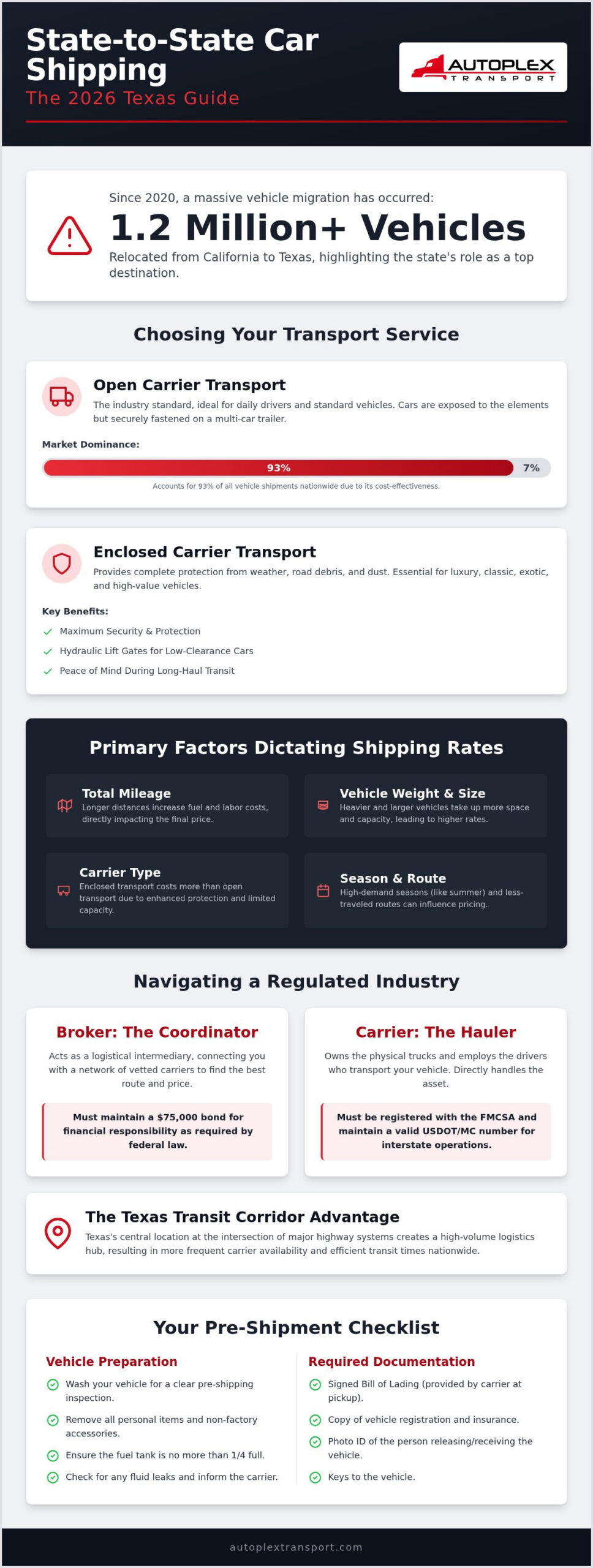
Texas occupies a unique position as the geographic heart of the southern United States. It functions as a massive logistics hub where major north-south and east-west highway systems intersect. This central location optimizes nationwide routes, allowing carriers to pivot efficiently between the East Coast, West Coast, and the Midwest. Because Texas is a high-volume transit corridor, vehicle owners often benefit from more frequent carrier availability and consistent transit speeds. This infrastructure makes the state a primary engine for national vehicle relocation, serving as a gateway for cars moving in every direction.
Broker vs. Carrier: Navigating the Industry
Understanding the distinction between a broker and a carrier is essential for a secure move. A carrier owns the physical trucks and employs the drivers, while a broker acts as a logistical intermediary. Understanding Auto Transport Brokers helps clarify that most companies you encounter online for state to state car shipping Texas are licensed to coordinate your shipment rather than haul it themselves. For the consumer, transparency in this network is vital. Federal regulations require brokers to maintain a $75,000 bond to ensure financial responsibility. Before booking, you should always verify a company’s national operating authority by checking their USDOT and Motor Carrier (MC) numbers. This verification ensures you are partnering with a legitimate corporate entity that values the security of your vehicle.
Choosing Your Service: Open vs. Enclosed Interstate Transport
Decisions on transport methods are usually driven by the vehicle’s value and the total distance of the route. Most owners prioritize a balance between security and cost. According to industry data from 2026, open transport remains the standard, accounting for 93% of all car shipments nationwide. When planning state to state car shipping Texas, the most fundamental decision you’ll face is selecting the equipment type. This choice impacts both your budget and the level of physical protection your vehicle receives during transit across multiple climate zones.
Open Carrier Car Transportation
This method is the primary solution for standard daily drivers and is the most common way to move vehicles across the country. Open carriers utilize multi-car trailers that can hold up to ten vehicles, which significantly optimizes fuel and logistics costs. This efficiency is passed on to the customer, making it the most cost-effective way to manage state to state car shipping Texas. While the vehicles are exposed to the elements, the safety record for open transport is excellent. Professional drivers use specialized tie-down systems to ensure stability over thousands of miles. For a deeper look at this process, you can consult The Comprehensive Guide to Open Transport Car Shipping in 2026.
Enclosed Transport Services
For luxury, classic, or high-value vehicles, enclosed transport provides an necessary layer of security. These trailers feature hard or soft sides that provide complete protection from road debris, dust, and varying weather patterns. When shipping a car across several states, your vehicle might encounter everything from desert sand to coastal humidity. Enclosed trailers often use specialized equipment, such as hydraulic lift gates, to safely load low-clearance vehicles without risking undercarriage damage. This is particularly important for performance cars that sit just inches off the ground.
While this service typically adds a surcharge of 40-60% compared to open carriers, the investment is often worth the peace of mind for rare or fragile assets. If you’re following a guide to shipping a car, you’ll see that enclosed options are frequently recommended for any vehicle where the paint finish or mechanical integrity is irreplaceable. You can find more details in Enclosed Car Transport: The Definitive Buying Guide for 2026. If you’re unsure which method fits your needs, our team at AutoPlex Transport Company can provide a tailored recommendation based on your specific vehicle and timeline.
Factors Influencing Nationwide Car Shipping Costs
Calculating the investment for state to state car shipping Texas involves more than just measuring the distance between two points. Logistics providers analyze a complex set of variables to determine a quote that ensures both safety and reliability. While mileage remains the primary driver of cost, factors like route density and infrastructure also play a role. For instance, routes that stay close to major national highway systems are often more efficient for carriers to navigate than those requiring significant detours into rural areas. This efficiency allows for more predictable scheduling and can influence the final rate.
Before booking, it’s wise to consult FMCSA consumer protection guidelines to understand how legitimate companies structure their services. Professional transporters provide all-inclusive quotes that account for the regulatory requirements of every state line crossed, including weigh station stops and electronic logging compliance. Door 2 Door Transportation has become the industry standard because it eliminates the logistical burden on the owner, providing a seamless transition from pickup to delivery without the need for terminal drop-offs.
Mileage and Route Complexity
Long-distance hauling relies on a price-per-mile model that typically decreases as the total distance increases. This doesn’t mean the total cost is lower; rather, the operational efficiency of the carrier improves over longer stretches of highway. Complexity arises when a route crosses regions with varying terrain or high-traffic corridors. Carriers must also account for state-specific regulations regarding trailer length and weight limits. When a vehicle is picked up near a major transit hub, the carrier can often secure a full load more quickly, which helps maintain a steady flow in the national network.
Vehicle Type and Condition
The physical characteristics of your vehicle directly impact carrier fuel consumption and space allocation. Larger SUVs and trucks take up more slot space on a trailer and add significant weight, which requires more fuel to transport. If a vehicle is inoperable, it necessitates specialized winching equipment to safely load it onto the carrier. This additional labor and equipment usage results in a higher service fee. It’s also essential to verify that your quote includes any necessary interstate permits for oversized vehicles. Ensuring your vehicle is clean and free of personal items is not just a preference; it’s a requirement under federal law to avoid fines at weigh stations.
Seasonal shifts also influence the national market. Industry data from 2026 indicates that demand typically peaks between May and August, which can increase rates by 10-15% due to high volume. Conversely, shipping during the winter months of January or February can offer savings of 5-10% as the market slows down. Planning your state to state car shipping Texas move around these cycles can help you secure the best value for your interstate relocation.
Preparing for Interstate Vehicle Transportation
Success in state to state car shipping Texas depends heavily on the preparation phase. While the carrier handles the heavy lifting, your role is to ensure the vehicle is legally and physically ready for a multi-day journey. Federal Department of Transportation (DOT) regulations strictly prohibit carriers from hauling personal household goods inside vehicles during transport. Removing these items protects you from potential fines at weigh stations and ensures the carrier stays within legal weight limits. It’s also a safety measure, as loose items can shift and cause interior damage during the long haul across state lines.
The Bill of Lading and Insurance
The Bill of Lading serves as your most critical legal protection throughout the shipping process. It functions as a receipt, a contract of carriage, and a detailed record of the vehicle’s condition at the point of pickup. The Bill of Lading is a binding contract between the vehicle owner and the carrier that outlines the terms of the transport and documents the state of the asset.
During the pre-transit inspection, you must walk around the vehicle with the driver to note every existing scratch, dent, or chip. This documentation is the foundation for any potential insurance claim. If the delivery inspection reveals new damage not listed on the original document, the Bill of Lading provides the evidence needed for a resolution. Don’t rush this process; a thorough inspection at the start provides peace of mind for the entire journey.
Vehicle Readiness Checklist
A clean exterior is necessary for an accurate inspection. Dirt and grime can easily hide small imperfections, leading to disputes later. Beyond aesthetics, you should ensure the vehicle is mechanically sound for loading and unloading. This includes maintaining proper tire pressure and keeping fluid levels at their standard operating range. However, you should only leave about a quarter tank of fuel to minimize unnecessary weight on the trailer.
For a detailed step-by-step guide on physical readiness, consult How to Prepare a Car for Transport: The 2026 Essential Checklist. If you’re moving into Texas, remember that you have 30 days to register your vehicle once you arrive. While safety inspections are no longer required for most non-commercial vehicles as of January 1, 2025, you may still need an emissions test if you’re moving to one of the 17 designated counties, such as Tarrant, Travis, or Williamson. Ready to start your move? Contact AutoPlex Transport Company to discuss your interstate logistics and receive an all-inclusive quote.
Why AutoPlex Leads in National Interstate Logistics
Choosing a partner for state to state car shipping Texas requires more than just finding a truck; it requires a relationship with a logistics expert who understands the national landscape. AutoPlex Transport Company operates from the heart of the Texas transit hub, leveraging years of experience to navigate the complexities of interstate movement. We recognize that your vehicle is a significant investment, which is why we provide transparent, all-inclusive quotes that eliminate the fear of hidden fees. Our pricing reflects the reality of 2026 logistics, ensuring that once you receive a rate, it remains the final figure for your move.
Our nationwide network is built on reliability and precision. By maintaining deep roots in the Texas corridor, we can offer more predictable pickup and delivery windows than companies that lack a physical presence in this critical junction. We don’t just coordinate shipments; we manage the entire lifecycle of the transport to ensure your vehicle arrives exactly when and where it’s expected. This stability allows us to act as a reliable partner for families and individuals relocating across the country.
Professional Reassurance and Safety
Safety is the cornerstone of our operations. We use a methodical vetting process for every carrier in our network, verifying insurance compliance and safety ratings through the latest FMCSA electronic systems. This level of scrutiny ensures that your vehicle is always in the hands of a qualified professional who meets the 2026 medical and operational standards. We prioritize clear customer communication throughout the transit period, providing regular updates so you’re never left wondering about the status of your asset. This proactive approach prevents common interstate delays by identifying potential logistical hurdles before they impact your timeline.
Seamless State-to-State Delivery
The convenience of our Door 2 Door Transportation model is designed to minimize your personal effort. We understand that navigating residential streets with a multi-car carrier requires specific expertise. Our drivers are trained to handle the complexities of local loading and unloading, ensuring a safe transition even in tight urban environments. If a street is too narrow for a large trailer, we coordinate a nearby meeting point that remains convenient for you while prioritizing the safety of the vehicle. This commitment to seamless logistics is why we remain a leader in state to state car shipping Texas.
Experience the security of working with a seasoned industry veteran who treats your vehicle with the care it deserves. Request your professional interstate car shipping quote today and let us handle the complexities of your next move.
Secure Your Vehicle’s Future Across State Lines
Moving your vehicle across the country doesn’t have to be a source of stress. By understanding the unique role of the Texas transit corridor and choosing between open and enclosed carriers based on your specific needs, you’ve already taken the first steps toward a successful relocation. Proper physical preparation and a thorough understanding of the Bill of Lading ensure your asset remains protected throughout its journey.
When you’re ready to finalize your plans for state to state car shipping Texas, partnering with a seasoned expert provides the security you deserve. Our team at AutoPlex Transport Company leverages deep expertise in Texas logistics hubs and a fully vetted carrier network to deliver nationwide door-to-door service with complete transparency. We prioritize safety and clear communication at every stage of the logistical process, ensuring you feel supported from pickup to delivery.
Take the next step in your relocation journey by securing a partner who treats your vehicle with professional care. Get a Reliable Interstate Shipping Quote from AutoPlex Transport today. We look forward to helping you move forward with confidence.
Frequently Asked Questions
How long does state-to-state car shipping to or from Texas take?
Transit times depend on the total distance and the specific route density. Once your vehicle is picked up, expect same-day to 1-day delivery within the major regional transit triangle. Moves to the Southeast typically take 2-5 days, while coast-to-coast shipments to the Pacific or Atlantic regions range from 3-8 days. These timelines account for weather conditions and federal driver rest requirements. We provide an estimated delivery window to help you plan your schedule effectively.
Is my vehicle insured during interstate transportation?
Yes, every carrier in our network must maintain valid cargo insurance to cover potential damages during transit. Your vehicle is protected from the moment it’s loaded onto the trailer until the final inspection at delivery. We verify the insurance credentials of our partners through the FMCSA database to ensure they meet 2026 compliance standards. You should also consult your personal insurance agent to see if your policy offers any additional coverage during a move.
Can I ship personal items inside my car during a state-to-state move?
Federal Department of Transportation regulations prohibit auto carriers from transporting personal household items inside the vehicle. Carriers aren’t licensed to move household goods and must stay within strict weight limits at weigh stations. Leaving items in your car can lead to fines, delays, or even theft. We recommend removing all personal belongings and aftermarket accessories to ensure a safe and compliant state to state car shipping Texas experience for everyone involved.
Do I need to be present for the pickup and delivery of my vehicle?
You or a designated representative over the age of 18 must be present at both the pickup and delivery locations. This presence is required to perform the joint vehicle inspection and sign the Bill of Lading. This document is the legally binding record of your vehicle’s condition. If you can’t be there personally, you can appoint a trusted friend or family member to act as your agent and handle the necessary paperwork.
What is the difference between a carrier and an auto transport broker?
An auto transport broker is a logistics professional who coordinates your shipment by matching you with a vetted carrier from an extensive national network. The carrier is the entity that owns the trucks and performs the physical transportation. Brokers handle the scheduling, insurance verification, and customer service. Since approximately 95% of companies in the industry are brokers, working with a reputable one ensures you receive the best equipment for your specific route.
How do I track my vehicle while it is in transit across state lines?
Tracking is typically managed through direct communication with the driver or a dedicated dispatcher. We provide regular status updates to keep you informed of your vehicle’s progress across state lines. In 2026, many carriers utilize electronic logging devices that provide real-time location data for better accuracy. You can always contact our support team for an updated ETA based on current traffic and weather conditions along the national transit corridor.
What happens if my vehicle is damaged during interstate shipping?
If you notice damage upon delivery, you must document it immediately on the Bill of Lading before the driver leaves. Take clear photographs of the new damage and compare them to the pickup inspection photos. This documentation is essential for filing a successful insurance claim. Our team will guide you through the process of contacting the carrier’s insurance provider to ensure a fair and timely resolution for any valid claims.
Are there specific regulations for shipping a car into Texas from another state?
Texas laws focus on administrative requirements following your vehicle’s arrival. New residents have 30 days to register their vehicle with the state. While mandatory safety inspections were eliminated for most non-commercial vehicles on January 1, 2025, you must still pass an emissions test if you relocate to one of the 17 designated counties within high-traffic metropolitan zones. Understanding these regulations ensures a compliant and smooth transition when utilizing state to state car shipping Texas services.