
The distance between two cities on a map is rarely the only factor that determines your vehicle’s arrival time. You’ve likely spent hours coordinating a move, only to realize that the biggest variable is the silent gap between handing over your keys and seeing your car again. It’s completely natural to feel anxious about how long to ship a car, especially when you’re balancing work schedules and family needs against a vague delivery estimate.
We understand that you need more than a guess; you need a reliable logistics partner. This 2026 guide provides the realistic timelines you can expect for nationwide transport, covering everything from the standard one to three business day pickup window to the final delivery at your door. You’ll discover how current FMCSA safety regulations and driver hour-of-service limits actually protect your vehicle while shaping the delivery clock. By the end of this article, you’ll have a clear understanding of regional versus cross-country transit times and the confidence to manage your transport schedule with total certainty.
Key Takeaways
- Understand the “Total Shipping Time” framework, which accounts for the initial booking phase and carrier assignment before your vehicle leaves the driveway.
- Learn how federal ELD mandates and driver safety regulations influence how long to ship a car by limiting daily driving hours to ensure secure transport.
- Gain realistic expectations for transit based on distance; professional carriers typically cover between 400 and 500 miles per day under normal conditions.
- Discover the “Two-Week Rule” and how booking 14 days in advance provides the necessary window to secure a priority spot on the most efficient routes.
- See how nationwide door-to-door services minimize local logistical delays by handling the entire journey from your current residence to your final destination.
Understanding the Car Shipping Timeline: The Total Duration Framework
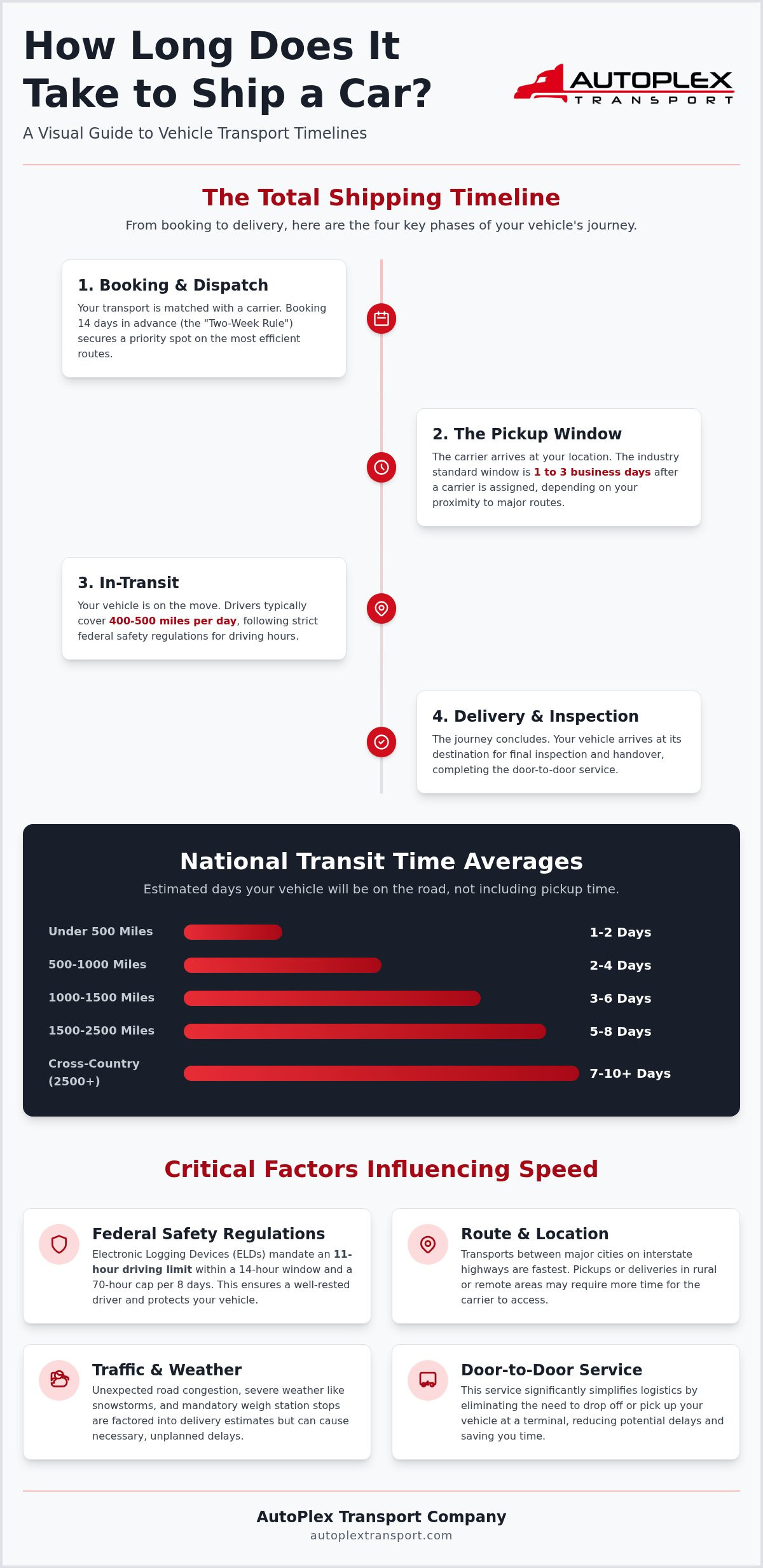
Understanding the total duration of vehicle transport requires looking past the odometer. Many first-time shippers assume the clock starts the moment they hang up the phone; however, the timeline is actually a multi-stage process. To accurately estimate how long to ship a car, you must account for the time it takes to secure a carrier, the period for the driver to arrive at your origin, and the actual transit days spent on the highway. We define “Total Shipping Time” as the entire window from the moment you book your service until the vehicle is safely offloaded at your new destination.
The Booking and Dispatch Phase
The process begins with the booking phase. This is when an Auto transport broker or dispatcher works to match your specific route with a carrier that has available space on their trailer. Securing a spot on a national route involves complex coordination. Carriers must align multiple pickups and drop-offs to remain efficient and keep costs manageable for the customer. Booking your service at least 14 days in advance often results in a smoother dispatch process. Last-minute requests can lead to longer wait times because you’re competing for limited trailer capacity on high-demand interstate routes.
You can also influence this phase by preparing your car for transport ahead of time. Having your documentation and vehicle ready ensures that once a carrier is assigned, there are no administrative hurdles to clear. This proactive approach helps the dispatcher prioritize your vehicle, as “ready-to-go” units are much easier to slot into a driver’s existing schedule.
The Pickup Window vs. Guaranteed Dates
Once a carrier is assigned, you enter the pickup window. While some companies might promise “guaranteed dates” to win your business, these are often unrealistic in the logistics industry. Traffic congestion, unpredictable weather, and loading delays at previous stops mean that a standard window of one to three business days is the industry norm for national pickups. In some cases, this may extend to five days depending on your proximity to major shipping hubs. We prioritize transparency over marketing promises because we believe you deserve a realistic schedule you can actually plan around.
Door-to-door transportation simplifies this window significantly. Instead of requiring you to drop your vehicle at a distant terminal, the carrier meets you as close to your residence as safely possible. This minimizes the time you spend coordinating local logistics. It also ensures the “Transit Time”—the actual days the vehicle spends on the trailer in motion—begins the moment the driver signs the Bill of Lading at your curb. By understanding these distinct phases, you can manage how long to ship a car with confidence and peace of mind.
Critical Factors That Determine Pickup and Delivery Speed
Distance provides the baseline for any transport estimate, but several external variables dictate the actual pace of your shipment. Many customers are surprised to learn that federal law, rather than driver preference, often sets the maximum speed for a cross-country move. Understanding these constraints helps you plan a realistic move-in date without the stress of unexpected delays or indefinite windows. When calculating how long to ship a car, you must weigh driver safety requirements against the physical availability of equipment on your specific route.
Federal Safety Regulations and Transit Speed
Federal law requires all commercial drivers to use Electronic Logging Devices (ELDs) to record their driving time, strictly limiting them to 11 hours of driving within a 14-hour on-duty window. These digital monitors ensure that every vehicle on the road is handled by a well-rested professional, but they also prevent the “non-stop” cross-country hauls that some might expect. Beyond daily limits, carriers must manage a 70-hour driving cap over an eight-day period. This means mandatory rest periods are a non-negotiable logistical step that protects both the driver and your asset.
While most standard shipments involve a solo driver, “team” drivers can occasionally be utilized to keep the truck moving for longer periods, though this is a premium service. Safety inspections and mandatory stops at highway weigh stations are also part of the journey. These checks are essential for maintaining road safety standards but add small, necessary increments to the total transit time. If you need a partner to navigate these complex federal requirements, the team at AutoPlex Transport acts as a steady hand to keep your logistics on track.
Carrier Availability and Equipment Type
The type of equipment you choose is one of the most significant factors in how long to ship a car. Because open transport car shipping accounts for roughly 90% of the national fleet, it usually offers the fastest booking times and the most flexible pickup windows. There are simply more of these trailers on the road at any given time, making it easier for dispatchers to find a spot on a carrier already moving through your area.
In contrast, enclosed car transport is a specialized service. Since these trailers are fewer in number, it may take longer to secure a carrier that is currently positioned on your specific route. Vehicle size also plays a role; larger SUVs and pickup trucks take up more physical space and weight capacity, which can sometimes limit a carrier’s ability to slot them into a nearly full trailer. While we focus on domestic logistics, those researching Shipping Your Vehicle Overseas will encounter even more complex equipment requirements and regulatory hurdles that significantly extend the shipping timeline beyond standard interstate expectations.
Distance vs. Transit Time: National Averages and Expectations
Transit time officially begins when your vehicle is secured on the trailer and the Bill of Lading is signed by both you and the driver. It is a common misconception that the clock starts at the moment of booking; however, the actual “over-the-road” phase is a distinct logistical period. Industry-wide car shipping statistics indicate that a professional carrier typically covers between 400 and 500 miles per day. This pace accounts for mandatory safety breaks and the physical realities of navigating a large multi-car trailer through varying traffic conditions. Understanding these daily averages is the first step in calculating how long to ship a car across different regions.
Mileage-Based Delivery Estimates
While every route has its own unique variables, we use standardized mileage tiers to provide our customers with reliable expectations. These estimates focus strictly on the time your vehicle is in motion on the interstate:
- 0-500 Miles: These regional moves usually take 1-2 days of transit time.
- 500-1,500 Miles: Mid-range shipments typically require 2-5 days to reach their destination.
- 1,500-3,000+ Miles: True cross-country hauls represent a specific logistical tier, often requiring 5-10 days of transit time.
A 2,800-mile trip from coast to coast is not simply a longer version of a short haul. It requires more frequent stops for fuel, rigorous vehicle inspections, and coordination across multiple time zones. By categorizing your move into these tiers, you can better visualize the journey your vehicle will take.
The Impact of “Multi-Car” Logistics
Your vehicle is rarely traveling alone. Most open carriers transport between 7 and 10 vehicles simultaneously to maximize efficiency and maintain affordable rates. This means the driver must coordinate multiple pickup and delivery points along the route. When you consider how long to ship a car, you must account for the time spent loading and unloading other vehicles at various stops. These stops are strategically planned to minimize deviations from the main interstate corridors, but they do influence the specific hour of your delivery.
The order of delivery often follows a “Last-On, First-Off” logic. This method allows the driver to deliver vehicles without constantly rearranging the entire trailer, which protects every car on the rack from unnecessary handling. Because of these variables, we encourage customers to maintain a degree of flexibility during their delivery day window. A driver might be ahead of schedule if a previous drop-off went quickly, or they could face minor delays due to local traffic at an earlier stop. Maintaining open communication with your carrier ensures you are ready when your vehicle arrives at its final destination.
How to Speed Up Your Vehicle Shipment: Proactive Planning
While external factors like federal mandates and route density are beyond your control, you have significant influence over the preparation phase of the journey. The most effective strategy for managing how long to ship a car is what we call the “Two-Week Rule.” Booking your transport at least 14 days in advance provides the dispatch team with a comfortable window to secure a spot on a carrier that is already scheduled for your specific route. If your needs are more urgent, expedited shipping is a viable alternative. By paying a priority premium, you can often secure a pickup window within 24 to 48 hours, effectively moving your vehicle to the front of the dispatch line.
Choosing the Right Service Level
Selecting the appropriate service level is a major factor in how quickly your vehicle enters the transit phase. Open carrier transport is almost always the fastest path to dispatch because these trailers make up the vast majority of the national fleet. Utilizing door-to-door transportation further streamlines the process by eliminating the days your vehicle might otherwise spend sitting at a third-party storage terminal. To ensure there are no delays once the driver arrives, you should maintain a “Ready-to-Go” status. This includes having the following items prepared:
- A spare set of keys for the driver.
- All necessary insurance and registration documents.
- A clean exterior to facilitate a quick and accurate initial inspection.
- The vehicle battery fully charged and tires properly inflated.
Optimizing the Pickup Location
The physical environment of your pickup location can either hinder or help the loading process. Large interstate transport trailers can reach 80 feet in length, making it nearly impossible for them to navigate narrow residential cul-de-sacs or streets with low-hanging branches. You can save several hours of maneuvering by offering to meet the driver at a nearby wide, accessible street or a large commercial parking lot close to a main highway. This flexibility allows the driver to load your vehicle safely and return to the interstate without delay.
Maintaining open communication is the final piece of the speed puzzle. Most professional drivers will provide a courtesy call 12 to 24 hours before their arrival to coordinate the exact meeting time. Being responsive to these calls prevents missed windows and ensures the driver can stick to their tight multi-state schedule. If you are ready to start planning your move with a partner that values your time, get a quote from AutoPlex Transport today to secure your preferred shipping window.
Navigating Logistics with AutoPlex: Reliable National Transport
Managing the complex logistics of vehicle transport requires a balance between regulatory compliance and operational efficiency. At AutoPlex, we act as the steady hand that guides your vehicle through each phase of the journey. By leveraging an extensive national network, we work to minimize the booking phase, which is often the most unpredictable part of the process. Our team understands that when you ask how long to ship a car, you aren’t looking for a vague marketing promise; you’re looking for a schedule you can use to plan your life. We prioritize transparent, realistic timelines that reflect the actual conditions of the road and the availability of our carriers.
Our commitment to safety is non-negotiable. We strictly adhere to federal ELD mandates, ensuring that every driver in our network is well-rested and operating within legal limits. While some may view these regulations as a hurdle to speed, we see them as a vital component of a successful delivery. A safe driver is a reliable driver, and by respecting these safety standards, we reduce the risk of delays caused by accidents or roadside violations. Our professional door-to-door logistics cover all 48 contiguous states, providing you with peace of mind that your vehicle is being managed by experienced hands from pickup to final delivery.
Expert Interstate Coordination
Navigating long-haul routes involves more than just driving; it requires expert coordination to avoid logistical bottlenecks. Our experience with interstate moves allows us to anticipate challenges like seasonal traffic patterns or route-specific equipment shortages before they impact your timeline. We take a carrier-first approach, building strong relationships with the professionals who actually move your vehicle. This rapport ensures that our loads are prioritized and that communication remains clear throughout the transit. We handle the administrative burdens and the constant tracking so you don’t have to worry about the minute details of nationwide transportation.
Your Next Steps for a Timely Move
Securing a realistic delivery window starts with early preparation. When you request a quote, providing accurate dates and a specific pickup location allows our dispatchers to begin the matching process immediately. Once your booking is confirmed, you can use our essential checklist to prepare your vehicle, ensuring that it’s ready for the driver the moment they arrive. This preparation is the most effective way to prevent administrative delays and keep your shipment on schedule. If you’re ready to experience a logistical process built on trust and transparency, get a reliable national transport quote from AutoPlex Transport today. We’ll provide you with a clear estimate of how long to ship a car based on your specific route and service needs, giving you the confidence to manage your next move with ease.
Planning Your Successful Nationwide Vehicle Move
Estimating how long to ship a car is no longer a matter of guesswork when you understand the logistical framework behind the scenes. You now know that a successful move relies on the synergy between early booking, adherence to federal safety mandates, and choosing the right equipment for your specific route. By recognizing the distinct phases of booking, pickup, and transit, you can coordinate your relocation with the precision of a seasoned professional. Logistics don’t have to be overwhelming when you have the right information.
Our team at AutoPlex Transport is here to manage these complexities on your behalf. We specialize in expert interstate logistics and professional door-to-door delivery using fully insured and vetted carriers. This comprehensive approach ensures that your vehicle remains in safe, capable hands from the moment of pickup to the final delivery at your new home. Whether you’re moving a standard sedan or a luxury SUV, we provide the steady hand and transparent communication you need for a stress-free experience.
Get Your Reliable Nationwide Shipping Quote Today and take the first step toward a seamless transport journey. We look forward to being your trusted partner on the road and helping you reach your next destination with total confidence.
Frequently Asked Questions
How long does it take to ship a car from the East Coast to the West Coast?
Transit time for coast to coast shipments typically ranges from 7 to 14 days once the vehicle is loaded. This timeline accounts for approximately 2,800 miles of travel. Professional drivers adhere to federal safety laws which limit daily driving to 11 hours, meaning they cover roughly 400 to 500 miles per day. When you include the initial pickup window of one to three business days, the total door to door duration usually falls between 10 and 17 days.
Can I get a guaranteed delivery date for my vehicle?
Guaranteed delivery dates are rare because the industry faces unpredictable variables like traffic, weather, and mechanical maintenance. While we provide a realistic delivery window, specific dates are often estimates rather than absolute guarantees. Professional carriers prioritize safety and compliance with federal driving limits over rushing. We focus on clear communication and real time updates so you’re never left wondering about your vehicle’s status. This approach ensures your car arrives safely without compromising on quality service.
Does the type of car I ship affect the delivery time?
Yes, vehicle type can influence the scheduling phase of your transport. Standard sedans and compact SUVs are the easiest to slot into open carriers because they fit standard trailer dimensions. Larger vehicles, such as lifted trucks or heavy dually pickups, may require more physical space or specialized weight capacity, which can extend the booking window. If you choose enclosed transport for a luxury or classic car, the limited number of these specialized trailers might also add a few days to your total timeline.
Why do some car shipping quotes take longer to fulfill than others?
Fulfillment speed often depends on route density and the current demand for carriers. Shipping between major metropolitan hubs is generally faster because there are more trucks moving along those corridors. If your pickup or delivery location is in a rural area far from the main interstate, it takes longer for a dispatcher to find a driver willing to divert from their primary route. Planning your move during peak seasons can also impact how long to ship a car.
Will weather conditions significantly delay my car shipment?
Severe weather is a common cause for minor transit delays. Snowstorms, heavy flooding, or high winds can force drivers to slow down or pull over to ensure the safety of their cargo. Since carriers are transporting up to ten vehicles at once, they must prioritize road safety over speed. While these events are out of our control, we maintain constant contact with our drivers to provide you with updated arrival windows whenever conditions change on the highway.
Is expedited car shipping worth the extra cost for a tight deadline?
Expedited shipping is a valuable option if you have a strict move in date. By paying a premium, your vehicle is moved to the top of the dispatch list, which often secures a pickup within 24 to 48 hours. This service doesn’t necessarily make the truck drive faster, as federal speed and hour of service laws still apply. However, it significantly reduces the booking phase and pickup window, which are the most common sources of time variability in the process.
How much notice do I need to give a transport company before pickup?
We recommend booking your service at least 14 days in advance. This two week rule provides enough time for dispatchers to match your vehicle with a carrier that’s already scheduled to pass through your area. While we can often accommodate shorter notices, providing a longer lead time increases the likelihood of securing your preferred pickup dates. Early booking is the most effective way to manage how long to ship a car while keeping your relocation schedule on track.
What happens if the driver arrives for pickup and I am not there?
If you can’t be present for the pickup, you should designate a trusted representative, such as a neighbor or family member, to act on your behalf. This person must be available to sign the Bill of Lading and conduct the initial vehicle inspection with the driver. If no one is available, the driver may have to move to their next stop to stay on schedule. This can cause significant delays and potential rescheduling fees, so coordination is essential for a smooth experience.