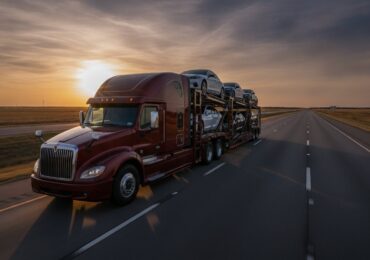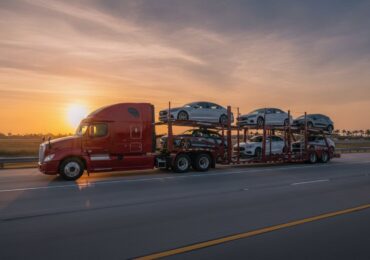
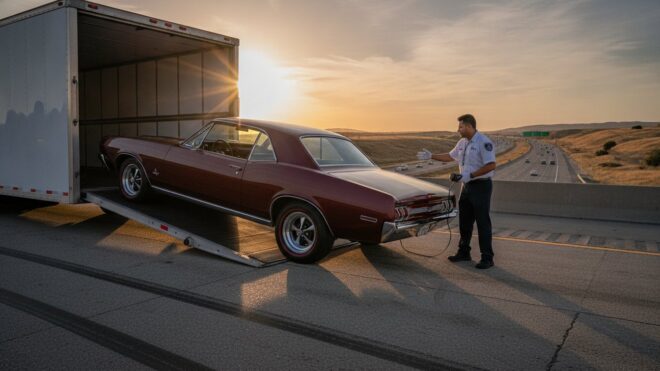
Shipping a classic car cross-country on an open trailer isn’t just a logistical decision; it’s a gamble with decades of history riding on the back of a flatbed. If you’ve ever watched a transporter roll past on the highway, kicking up road debris at 70 miles per hour, you already understand the anxiety that comes with trusting someone else to move something irreplaceable.
That concern is completely valid. Classic car owners aren’t just moving a vehicle from one point to another; they’re protecting a carefully preserved asset whose condition directly determines its value. The difference between arriving with a pristine engine bay and a stone-chipped hood often comes down to one choice: the quality of the classic car transport services you select before the truck ever pulls out of your driveway.
This guide is built to give you total clarity on that choice. You’ll learn how enclosed carriers protect against weather and road debris, why door-to-door delivery minimizes unnecessary handling, and how to distinguish a specialized carrier from a general freight broker. By the end, you’ll know exactly what to look for and what questions to ask before your vehicle moves an inch.
Key Takeaways
- Professional classic car transport services operate as a specialized logistics tier, and understanding what separates them from standard auto shipping is the first step toward protecting your vehicle’s condition and value.
- Enclosed carriers provide total isolation from environmental hazards — including UV exposure, rain, hail, and road debris — making them the industry standard for vintage and collector vehicles with original paintwork.
- The equipment a carrier uses matters as much as the carrier itself; hydraulic lift gates and soft-tie systems are essential for loading low-clearance classics without risking frame damage or undercarriage scratches.
- A proper pre-shipment checklist, including a mechanical inspection and following the quarter-tank fuel rule, can prevent avoidable complications before your vehicle ever leaves the driveway.
- Verifying a carrier’s federal DOT and MC credentials — and knowing whether you’re working with a direct carrier or a broker — are the two most important steps in selecting a trustworthy transport partner.
What Defines Professional Classic Car Transport Services?
Not every vehicle transport company is equipped to move a 1967 Shelby GT500 or a fully restored 1957 Chevrolet Bel Air. Professional classic car transport services occupy a distinct tier within the logistics industry, one built around climate-controlled environments, zero-exposure transit protocols, and drivers who understand that a vehicle with decades of history requires an entirely different level of care than a leased sedan headed to a dealership lot.
The distinction between standard auto shipping and specialized collector vehicle transport comes down to what’s at stake. A general freight broker is optimized for volume and speed. A specialized carrier is optimized for preservation. Those two goals are rarely compatible, and for owners of vehicles that meet classic car definitions and collector vehicle standards, the difference in approach translates directly into the condition your vehicle arrives in.
Specialized drivers bring a specific knowledge set that general haulers simply don’t have. Classic vehicles often have quirks that require careful handling:
- Starting sensitivity: Carbureted engines need a different startup procedure than modern fuel-injected vehicles, and flooding the engine during loading can cause real mechanical damage.
- Brake characteristics: Drum brake systems common in pre-1970s vehicles require more stopping distance and a different pedal feel, which an unfamiliar driver can mishandle during loading and unloading.
- Suspension limitations: Lowered or stiffened suspensions on restored classics can’t absorb the same loading ramp angles that modern cars handle without issue.
This is the core difference between “hauling” a car and executing a curated vehicle relocation. The former treats your vehicle as cargo. The latter treats it as an asset with a documented history and a market value that depends on its condition remaining intact.
The Financial Impact of Proper Transportation
Improper transport doesn’t just risk cosmetic damage; it can trigger what appraisers call “diminished value,” a documented reduction in what a vehicle is worth even after repairs are made. A repainted panel, no matter how well executed, breaks the originality record that concours judges and private buyers scrutinize closely. The cost-benefit calculation is straightforward: the premium for enclosed, specialized transport is almost always a fraction of what a single paint correction or mechanical repair would cost on a vehicle of significant value.
Meeting the Needs of Different Collector Types
Not every classic arrives at the transporter in pristine, running condition. Concours d’elegance entries demand climate-controlled enclosures to protect delicate lacquer finishes and hand-stitched interiors from humidity fluctuations. Project cars and non-runners require specialized winching equipment and flatbed configurations that load without placing stress on the drivetrain or frame. Door-to-door delivery minimizes the number of times a vehicle changes hands, which matters enormously for both categories. Fewer handoffs means fewer opportunities for something to go wrong.
The Critical Choice: Why Enclosed Carriers are the Industry Standard
Open transport works perfectly well for a late-model commuter car. For a vehicle with original lacquer, hand-stitched leather, or a matching-numbers drivetrain, it’s a different calculation entirely. Enclosed carriers exist because the threats to a classic vehicle in transit are real, constant, and largely invisible until the damage is already done.
The environmental exposure during a cross-country haul compounds quickly. UV radiation degrades original paint chemistry over prolonged exposure, particularly on pre-1980s finishes that weren’t formulated with modern UV inhibitors. Rain and hail are obvious concerns, but road salt spray and industrial fallout — the microscopic metallic particles released by rail yards, industrial corridors, and highway construction zones — are threats that rarely get mentioned. These contaminants bond to paint surfaces and cause oxidation that no detailing session fully reverses. An enclosed trailer eliminates all of it.
There’s also a security dimension that’s easy to overlook. A classic car sitting on an open trailer at a truck stop overnight is visible to anyone who happens to walk through the lot. Enclosed transit removes that visibility entirely. The vehicle is sealed, anonymous, and inaccessible throughout the journey.
Hard-Side vs. Soft-Side Enclosed Trailers
Not all enclosed trailers offer the same level of protection. Hard-side trailers, constructed with rigid aluminum or composite panels, provide a fully sealed environment that resists wind-driven rain, hail impact, and forced entry. Soft-side trailers use curtain-style panels that reduce debris exposure significantly but don’t offer the same structural integrity against weather or physical impact. For long-distance interstate shipments or any vehicle with irreplaceable original paint, hard-side is the appropriate standard. Soft-side enclosures may be acceptable for shorter regional moves where weather risk is minimal, but they shouldn’t be the default choice for high-value collector vehicles. Our enclosed car transport guide covers trailer specifications in much greater detail if you want to compare configurations before booking.
The ‘White Glove’ Handling Protocol
The trailer itself is only part of the equation. How a vehicle is handled during loading and unloading determines whether the enclosure’s protection actually holds. Qualified drivers working with classic car transport services use floor coverings to protect against boot scuffs and drips, and steering wheel wraps to prevent oils and residue from contacting original materials. They understand how to operate a carbureted engine without flooding it, and they know that a drum-brake vehicle loaded onto a ramp requires a slower, more deliberate approach than a modern car with ABS. These aren’t optional courtesies; they’re the baseline standard for any carrier that genuinely specializes in collector vehicles.
If you’re evaluating carriers, ask specifically about their loading protocol. A professional operation will describe it without hesitation. Vague answers about “careful handling” are a signal worth paying attention to before you commit your vehicle to their care.
Specialized Equipment: Lift Gates, Soft Ties, and Low-Clearance Solutions
The trailer type is only half the equation. What happens at the moment of loading often determines whether a vehicle arrives in the same condition it left. For classic car transport services, the equipment a carrier brings to your driveway is as important as any credential they hold, and the gap between adequate and specialized becomes most visible when a low-clearance vehicle meets a standard loading ramp.
Hydraulic Lift Gates vs. Ramps
Traditional loading ramps create an angle problem. A ramp steep enough to reach a trailer deck will force a low-slung front splitter, chin spoiler, or custom front valance into contact with the ramp surface before the rear wheels have even begun to climb. For a 1969 Corvette Stingray with a restored front end, or any classic European sports car sitting close to the ground, that moment of contact can cause irreversible damage to bodywork that took months to restore.
Hydraulic lift gates solve this by eliminating the angle entirely. The platform descends to ground level, the vehicle drives or rolls onto a flat surface, and the entire platform rises horizontally to trailer height. There’s no ramp angle, no scraping risk, and no stress placed on a front air dam or custom spoiler. When you’re evaluating carriers, ask directly whether they use a hydraulic lift system for low-clearance vehicles. A carrier who can’t answer that question specifically doesn’t have one.
Advanced Securing Techniques
Once a vehicle is loaded, how it’s held in place during transit matters just as much as how it got there. The securing method determines whether your vehicle arrives with its frame, undercarriage, and bodywork exactly as you left them.
- Nylon over-the-tire straps: These distribute tension across the tire sidewall rather than attaching directly to the vehicle’s chassis or suspension components. They’re the correct choice for vehicles with original or restored undercarriages where any contact point is a potential scratch risk.
- Chassis-hook systems: These attach to designated tie-down points on the vehicle’s frame and are appropriate when a manufacturer has specified those points. They require the driver to know exactly where those points are on your specific model, which is why specialized knowledge matters.
- Multi-point tie-downs: Long-distance interstate transport introduces sustained vibration, lateral movement through curves, and braking forces that accumulate over hundreds of miles. A four-point or six-point securing system distributes those forces evenly and prevents the vehicle from shifting incrementally during the journey.
Metal chains should never contact a classic car’s frame; even brief contact transfers enough vibration and abrasion to damage original finishes and compromise structural coatings that took years to develop.
Two additional equipment standards separate professional operations from general haulers. Air-ride suspension trailers absorb road vibration at the axle level rather than transmitting it through the vehicle’s own suspension, which matters significantly for restored classics with period-correct rubber bushings that weren’t designed for highway frequencies over long distances. Satellite tracking gives owners real-time visibility throughout the journey, which removes the anxiety of a vehicle being somewhere on an interstate with no way to confirm its location or status. Both features are worth asking about before you book.
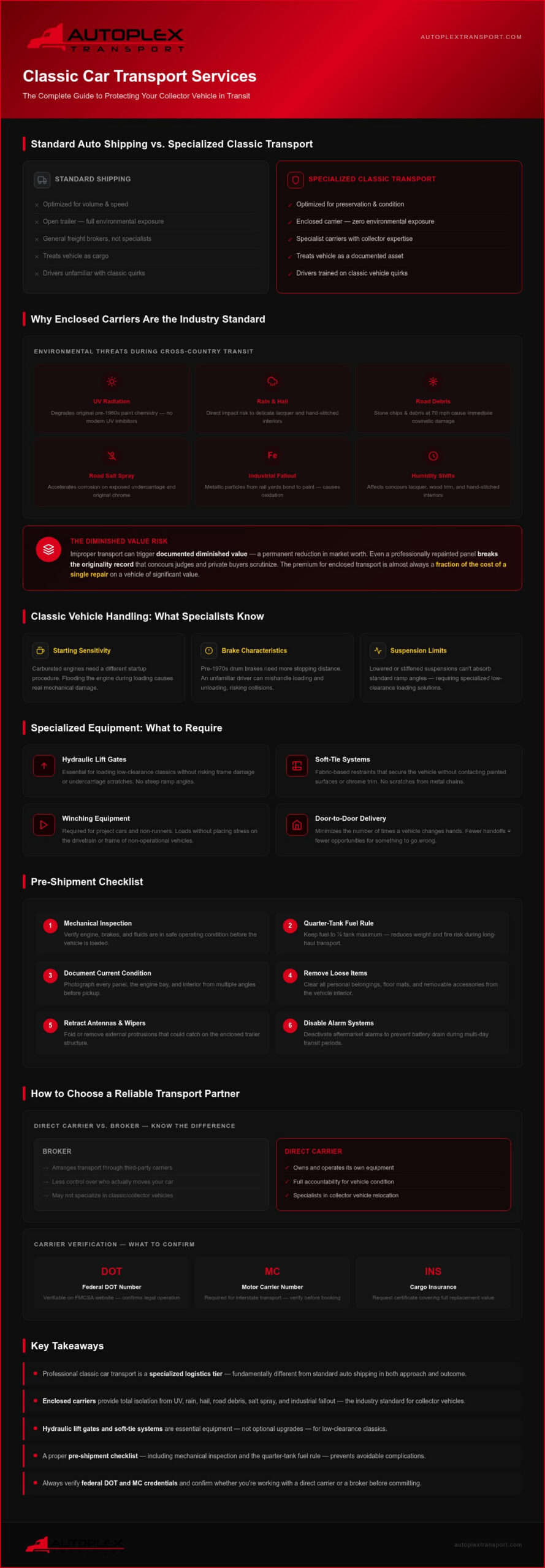
Preparing Your Classic for Nationwide Shipment: A 2026 Checklist
Choosing the right classic car transport services is the most critical step, but your role as the owner doesn’t end once the contract is signed. The physical preparation of your vehicle ensures that the specialized equipment and handling protocols can do their jobs effectively. A well-prepared car is a protected car, and following a chronological sequence of steps helps eliminate the small variables that lead to transit delays.
Start with a thorough mechanical inspection. While your car will be handled with care, it still needs to be in a condition that allows for safe loading. This includes checking that the tires hold air and the steering remains functional. You should also follow the “quarter-tank” rule. Maintaining a fuel level at approximately 25% provides enough fuel for the driver to move the vehicle safely while significantly reducing the overall weight of the shipment. This balance is a standard safety regulation across the logistics industry to minimize fire risk and keep trailer weight within federal limits.
Documentation is your primary protection against ambiguity. Take high-resolution photographs of every angle of the vehicle, including the undercarriage and interior, immediately before the carrier arrives. These photos serve as a timestamped record for insurance purposes should any question arise upon delivery. For a more detailed breakdown of these steps, follow our essential checklist for car preparation to ensure a smooth pickup process.
Fluid Management and Battery Care
Vintage engines are often prone to minor leaks, which becomes a concern in multi-car enclosed trailers. Diapering a car, which involves placing a protective absorbent material under the engine or transmission, is a standard courtesy that prevents your vehicle’s fluids from dripping onto others. Additionally, isolate the battery if your classic has a sensitive electrical system. Use a battery disconnect switch or remove the negative cable to prevent discharge during long-distance transit. Finally, ensure you’ve discussed with the driver whether the car should be left in neutral or a specific gear once secured.
The Bill of Lading (BOL) and Condition Reports
The Bill of Lading is more than a receipt; it’s a binding legal document that records the vehicle’s condition at the point of exchange. When the driver arrives, you’ll perform a joint walk-around. Mark every existing imperfection, no matter how small, clearly on the BOL. Never sign this document at pickup or delivery without a physical inspection. The signature at delivery confirms that the vehicle was received in the same state it was picked up, making it the most important piece of paperwork in the entire process.
If you’re ready to start the process with a partner who understands these nuances, you can request a personalized transport quote today.
How to Choose a Reliable Classic Car Transport Partner
The final safeguard for your vehicle isn’t a strap or a trailer; it’s the professional integrity of the company you hire. Selecting a provider for classic car transport services requires a more rigorous vetting process than standard auto shipping. You are looking for a partner that manages every detail of the journey with the same level of care you provide in your own garage.
Start by verifying federal credentials. Every legitimate interstate carrier must possess active Department of Transportation (DOT) and Motor Carrier (MC) numbers. These identifiers allow you to check safety records and insurance status through the Federal Motor Carrier Safety Administration (FMCSA) database. If a company is reluctant to share these numbers, they aren’t a viable option for a high-value asset.
It’s also vital to understand whether you’re speaking with a direct carrier or a logistics broker. A broker acts as a middleman to find a driver, while a direct carrier owns the equipment and employs the staff. AutoPlex Transport focuses on specialized door-to-door logistics to ensure your vehicle remains under a consistent chain of command. This model minimizes the number of times your car is handled and provides a direct line of communication between you and the person behind the wheel.
Assess cargo insurance with a critical eye. Standard carrier insurance may cover general damages, but it often fails to meet the “agreed value” requirements of a rare collector vehicle. Ask about gap coverage and verify that the policy limits align with your vehicle’s current market valuation. In 2026, a reputable carrier should provide clear, written documentation of their insurance limits before you sign a contract.
Vetting Driver Experience and Reviews
Look beyond the overall star rating. Search for reviews that specifically mention “classic,” “vintage,” or “exotic” vehicle handling. A driver who is excellent at moving fleet trucks might not have the specialized training required for a non-synchromesh gearbox or a sensitive manual choke. Ask about driver tenure; experienced hands who have handled hundreds of high-value relocations offer a level of intuition that newer drivers simply haven’t developed yet. A dedicated point of contact throughout the process is also essential. You should never feel like your vehicle has disappeared into a logistical black hole.
Finalizing the Quote and Timeline
The cheapest quote in your inbox is often a warning sign. Low-cost providers frequently cut corners on equipment maintenance, driver pay, or insurance coverage. High-quality classic car transport services require specialized hardware like hydraulic lift gates and air-ride trailers, which carry higher operational costs. Be aware of seasonal impacts as well. Nationwide routes often see increased demand during major auction cycles or “snowbird” seasons, which can affect both pricing and availability. Taking the time to secure a realistic quote ensures your vehicle receives the priority it deserves. To begin your journey with a partner who prioritizes safety, request a specialized quote from AutoPlex Transport today.
Your Classic Deserves a Transport Partner Who Treats It That Way
Moving a collector vehicle across the country isn’t a task you hand off casually. The decisions you make before the carrier arrives, from choosing enclosed transport over open trailers to verifying federal credentials and preparing a thorough Bill of Lading, are what separate a smooth delivery from a costly dispute.
The core principle running through every section of this guide is the same: classic car transport services exist on a specialized tier, and the carriers who operate at that level bring equipment, training, and accountability that general haulers simply don’t offer. Matching your vehicle to that level of care is the most important investment you can make before it leaves your driveway.
AutoPlex Transport provides expert enclosed carriers, white-glove door-to-door service, and nationwide interstate coverage designed specifically for vehicles that can’t afford a compromise. When you’re ready to move forward with a partner who understands what’s at stake, get a professional classic car transport quote from AutoPlex and take the first step toward a delivery you can feel confident about.
Frequently Asked Questions About Classic Car Transport Services
Is enclosed transport really necessary for a classic car?
For most classic vehicles, yes. Open transport exposes your car to road debris, UV radiation, rain, industrial fallout, and overnight visibility at truck stops throughout the entire journey. A single stone chip on original lacquer or a hail strike on a restored hood can cost far more to repair than the price difference between open and enclosed service.
The exception might be a project car in rough cosmetic condition where surface damage isn’t a concern. For anything with original paintwork, a matching-numbers drivetrain, or significant appraised value, enclosed transport isn’t a luxury upgrade; it’s the appropriate baseline.
How much insurance coverage do I need for my classic car shipment?
Your coverage should match the vehicle’s current agreed value, not its replacement cost or book value. Standard carrier liability policies are often structured around depreciated market values, which can leave a significant gap for a rare collector vehicle appraised well above typical market comparables. Before booking, ask the carrier for written documentation of their cargo insurance limits and verify those limits align with what your vehicle is actually worth.
It’s also worth checking whether your existing collector car insurance policy provides any transit coverage. Some specialty insurers extend protection during transport, which can supplement a carrier’s policy and close any remaining gap without requiring a separate rider.
Can I ship extra spare parts inside the vehicle?
Most reputable carriers prohibit personal items and loose cargo inside the vehicle during transport. The reason is straightforward: unsecured items shift during transit and can damage interior panels, upholstery, and trim. Beyond the physical risk, most carrier insurance policies explicitly exclude personal property stored inside a vehicle, meaning any damage to those items wouldn’t be covered under the shipment agreement.
If you need to move period-correct spare parts alongside your vehicle, ask the carrier whether they can accommodate a separately secured and documented container. Don’t assume that placing items in the trunk is an acceptable workaround; confirm the policy in writing before loading day.
How long does nationwide interstate car shipping take?
Transit times for classic car transport services vary based on route distance, carrier scheduling, and whether you’re booking a dedicated single-vehicle load or a shared enclosed trailer. A coast-to-coast shipment typically takes between seven and fourteen days from pickup to delivery. Shorter regional routes, such as a mid-Atlantic to Southeast move, generally complete within three to five days.
Dedicated transport, where your vehicle is the only one on the trailer, tends to move faster because the driver isn’t coordinating multiple pickup and delivery stops. If your timeline is firm, such as a delivery deadline tied to an auction or show, discuss that constraint with your carrier upfront so scheduling can be structured accordingly.
Do I need to be present for the pickup and delivery of my car?
You or a designated representative should be present at both the pickup and delivery points. At pickup, you’ll conduct a joint walk-around with the driver to document the vehicle’s condition on the Bill of Lading. At delivery, that same inspection confirms the car arrived in identical condition. Signing off remotely or allowing someone unfamiliar with the vehicle’s pre-existing condition to accept delivery creates ambiguity that’s very difficult to resolve after the fact.
If you genuinely can’t be present, designate someone who knows the vehicle well and has access to your pre-shipment photographs. That person needs to understand that their signature on the delivery Bill of Lading carries legal weight and shouldn’t be given without a thorough physical inspection.
What happens if my classic car is non-operational?
Non-operational vehicles require specialized loading equipment, specifically a winch system or hydraulic lift gate, because the car can’t be driven onto the trailer under its own power. Not every carrier maintains this equipment, so it’s essential to disclose the vehicle’s non-operational status when requesting a quote. Attempting to load a non-runner without proper equipment risks frame stress, undercarriage damage, and potential injury to the driver.
Expect a modest additional fee for non-operational handling; it reflects the extra time, equipment, and care involved. A carrier who quotes a non-runner at the same price as a running vehicle without acknowledging the difference is a signal worth investigating before you commit.
Will my car be driven at any point during the transport process?
Yes, but minimally. The driver will need to move the vehicle during loading and unloading, which typically involves starting the engine and driving a short distance onto or off the trailer. This is why specialized carriers need to understand the mechanical characteristics of your specific vehicle, including carburetor startup procedures, drum brake behavior, and suspension limitations.
Beyond those brief loading movements, a professional carrier won’t drive your vehicle for any other purpose. If you have concerns about a particularly sensitive drivetrain or a non-synchromesh gearbox, communicate those specifics to the carrier before pickup so the driver arrives prepared. Door-to-door delivery minimizes these handling moments by eliminating intermediate terminal stops entirely.
How far in advance should I book my classic car transport service?
Booking two to four weeks ahead is a reasonable standard for most interstate routes. During peak periods, including major auction seasons, spring and fall show circuits, and the seasonal migration patterns of snowbird routes, availability for enclosed carriers tightens considerably and last-minute bookings become difficult to fulfill without compromising on carrier quality.
If your shipment is tied to a specific event date, such as a concours entry deadline or a private sale handover, build in additional lead time beyond the transit window itself. Confirming a carrier early also gives you time to complete the mechanical inspection, prepare your documentation, and address any fluid or battery issues before pickup day arrives.