
Your vehicle is one of your most significant investments, yet many owners don’t realize that the safety of their car during transit starts long before the carrier arrives. It’s natural to feel anxious about potential damage or confused by the fine print of insurance policies while your vehicle travels across state lines. Understanding exactly how to prepare a car for transport is the most effective way to mitigate these risks and gain total peace of mind. By taking a proactive approach, you aren’t just making the driver’s job easier; you’re creating a documented safety net for your property.
In this master guide, you’ll learn the professional protocols to secure your vehicle, satisfy the latest 2026 insurance requirements, and guarantee a seamless nationwide shipping experience. We will walk you through a methodical checklist that includes mechanical inspections, the critical role of the Bill of Lading, and the truth about personal items in your vehicle. From verifying USDOT credentials to managing fuel levels for current weight standards, this guide provides the clarity you need for a damage-free delivery and a smooth pickup process with your driver.
Key Takeaways
- Understand why proper vehicle preparation is the foundation of a successful transport and how it defines the line between owner responsibility and carrier liability.
- Learn why a professional exterior wash is necessary to identify pre-existing damage and create an accurate photographic record for your insurance files.
- Discover exactly how to prepare a car for transport by following the “Empty Car” rule and managing fuel levels to meet 2026 weight standards.
- Identify the specific preparation nuances required for both open and enclosed transport methods to protect against road debris or low-clearance issues.
- Master the Bill of Lading process to ensure you’re legally protected through a thorough joint inspection with your professional transport driver.
Why Proper Vehicle Preparation is Essential for Safe Transport
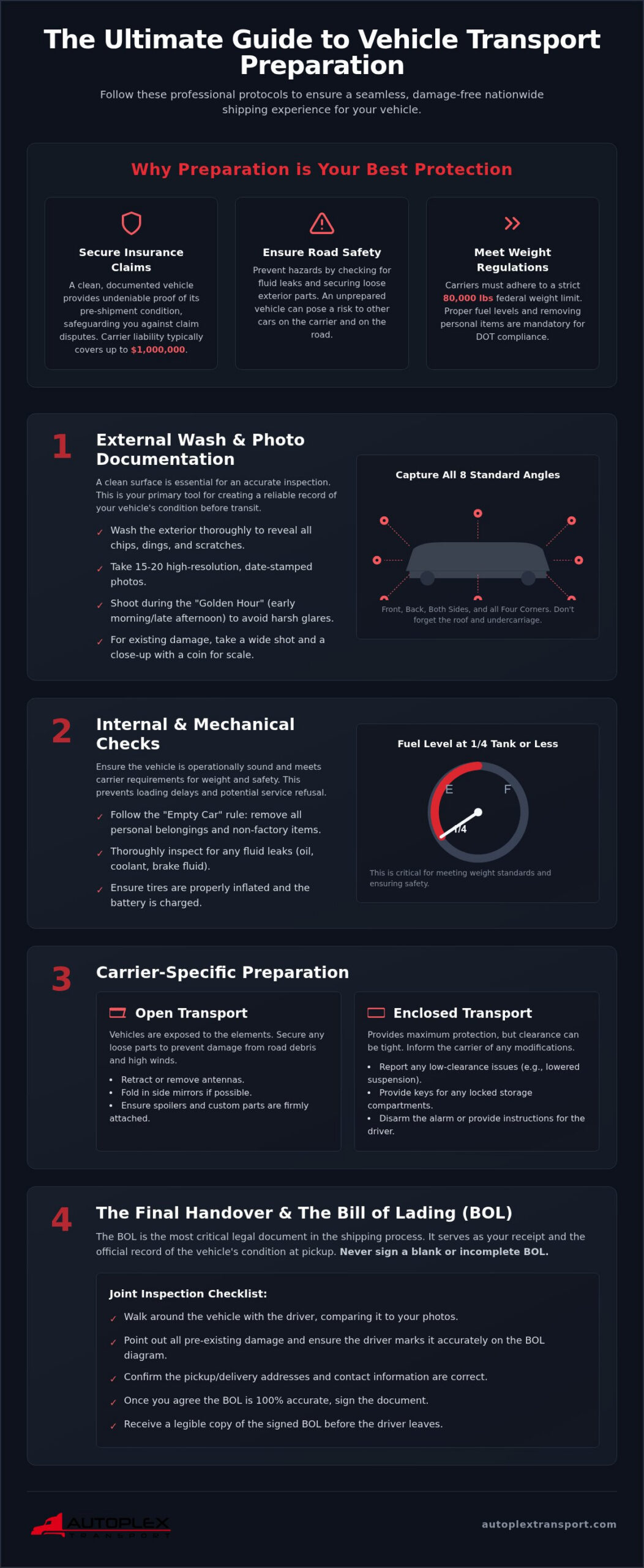
Proper vehicle preparation serves as the essential bridge between your responsibilities as an owner and the carrier’s legal liability. When you understand how to prepare a car for transport, you aren’t just performing a chore; you’re establishing a legal safeguard for your asset. A carrier’s insurance policy, which typically carries a liability minimum of $1,000,000 in 2026, only covers damage that occurs while the vehicle is in their professional care. If your car isn’t properly cleaned and inspected before the truck arrives, proving when a scratch or dent occurred becomes nearly impossible. This lack of clarity can lead to denied claims and unnecessary financial stress.
Beyond insurance protections, preparation directly impacts physical road safety. Loose exterior parts or fluid leaks can cause significant damage to other vehicles on the trailer or even create hazards for trailing motorists. Because the federal maximum weight for a loaded car carrier is 80,000 pounds, drivers must be meticulous about every vehicle they load. An improperly prepared car, such as one with a full tank of gas or excessive personal weight, can jeopardize the carrier’s compliance with DOT regulations. In these instances, a driver may refuse service to protect their equipment and their professional license, leading to costly delays for your move.
The Legal Role of Preparation in Insurance Claims
Establishing a baseline condition is your most powerful tool in the event of a claim. By documenting every existing chip, ding, or scratch, you create a clear record that prevents disputes later. This documentation is vital for nationwide transport where your vehicle may pass through various climates and handling stages. Without a clean exterior, a driver cannot accurately note the car’s condition on the Bill of Lading. If the car is covered in road grime, any damage found at delivery could be dismissed as pre-existing, leaving you to cover the repair costs out of pocket.
Maximizing Efficiency for Nationwide Logistics
The 2026 shipping season is seeing record volumes, with the industry growing at a rate of 4-6% annually. This high demand means drivers operate on incredibly tight interstate schedules. When you know how to prepare a car for transport effectively, you ensure the pickup process is swift and professional. Efficiency on the road is often modeled after the standardized loading seen in Roll-on/roll-off (RORO) ships, where speed and safety depend on every unit being ready for immediate movement. A prepared vehicle allows the driver to secure the load quickly and hit the road, ensuring your car and the others on the trailer arrive at their destination on schedule.
External Cleaning and Condition Documentation Strategies
A professional exterior wash is the first practical step when you’re looking at how to prepare a car for transport. While it might seem counterintuitive to clean a vehicle that will soon be exposed to highway dust, a clean surface is the only way to perform a valid condition inspection. Road grime, mud, and salt can easily obscure small chips, dings, and scratches that a driver needs to note on the Bill of Lading. By presenting a spotless vehicle, you enable a transparent and accurate assessment, which is your best defense against future disputes.
Timing your documentation is just as critical as the cleaning itself. We recommend following the “Golden Hour” rule, which involves taking your inspection photos during the soft, directional light of early morning or late afternoon. Harsh midday sun creates deep shadows and high-contrast glares that can hide subtle dents or paint imperfections. Don’t limit your documentation to just the side panels. It’s essential to capture clear images of the roof and the undercarriage, as these areas are often overlooked but can be vulnerable to road debris during interstate travel.
Professional Photography Standards for Vehicle Shipping
To ensure your documentation holds up under scrutiny, you must capture date-stamped, high-resolution images from all eight standard angles: front, back, both sides, and all four corners. If you find an existing imperfection, take a wide shot first to show its location, followed by a close-up with a common object like a coin for scale. The ideal photo set consists of 15-20 clear, well-lit images that provide a 360-degree digital record of the vehicle. This level of detail provides the peace of mind that comes from knowing you have a “digital twin” of your car’s condition before it enters the care of AutoPlex Transport Company.
Exterior Accessory Removal and Security
Once the car is clean and documented, you must secure or remove any external components that could catch the wind or vibrate during transit. This includes retracting or unscrewing non-permanent antennas and folding in side mirrors to minimize the vehicle’s footprint. If you have loose trim pieces or a convertible top, check that everything is tightly sealed and fastened to prevent air from getting underneath at highway speeds. Finally, remember to remove toll tags, parking passes, and GPS transponders from the windshield. If left inside, these devices can be triggered by toll gantries while the car is on the trailer, leading to unexpected charges on your accounts.
Internal Preparation and Mechanical Maintenance Requirements
While exterior documentation is vital for your legal protection, the internal state of your vehicle determines the physical safety and efficiency of the journey. One of the most common points of confusion regarding how to prepare a car for transport involves personal belongings and interior storage. Many owners assume they can use their car as an extra shipping container, but this practice presents significant risks to the vehicle and the carrier’s compliance with federal regulations. Professional carriers operate under strict weight limits, and their insurance policies are designed to cover the vehicle itself, not the household items left inside.
Adhering to the “Empty Car” rule is a standard industry requirement. Carrier insurance does not extend to personal electronics, luggage, or loose items, meaning any loss or damage to these goods will not be covered by a claim. Most transport companies allow for a 100-pound limit of essential vehicle equipment, such as a spare tire, jack, or emergency road kit, provided these items are secured in the trunk. Beyond the weight concerns, it’s necessary to disable all car alarms before the driver arrives. If an alarm triggers during transit, the driver cannot easily reset it while moving, which often leads to a completely drained battery by the time the car reaches its destination.
Mechanical integrity is another pillar of successful preparation. Even if your car is being towed, it needs to be in a safe condition for the driver to handle. If you need a pre-transport inspection to ensure there are no hidden issues, Fix My Car offers professional diagnostic services to guarantee your vehicle is ready for the journey. Checking for fluid leaks is a courtesy to other owners; a car leaking oil or transmission fluid on an upper rack can cause permanent paint damage to the vehicles secured on the lower level. If your vehicle has a known slow leak, you must inform the driver so they can position the car appropriately on the trailer to prevent damage to other cargo.
The Essential Mechanical Readiness Checklist
A vehicle must be in “run and drive” condition unless you’ve specifically booked an inoperable transport service. Ensure the battery is fully charged and that the terminal connections are secure to prevent any electrical issues during loading. You should also check your tire pressure to facilitate safe movement on and off the trailer ramps. While some generic guides suggest emptying your gas tank, professional standards in 2026 recommend maintaining approximately a 1/4 tank of fuel. This provides enough weight for stability and ensures the driver has sufficient fuel to move the vehicle during the loading and unloading process without adding unnecessary weight to the carrier.
Securing the Interior Environment
Take a moment to remove all loose electronics, charging cables, and hanging air fresheners that could rattle or fall during the trip. Ensure all windows are fully closed and locked to maintain a weather-tight seal and prevent road dust from entering the cabin. It’s a safety necessity to clear the cabin because internal items can become projectiles during sudden stops or sharp maneuvers. By stripping the interior to its factory state, you ensure the cabin remains as pristine as the day it was picked up, allowing you to focus on how to prepare a car for transport from a purely logistical perspective.
Carrier-Specific Preparation: Open vs. Enclosed Transport
Choosing between carrier types dictates the final technical adjustments you must make before the driver arrives. While previous steps established a baseline of cleanliness and documentation, learning how to prepare a car for transport requires understanding the physical environment of the trailer. For those utilizing open transport car shipping, the vehicle is exposed to varied weather patterns and highway wind turbulence. This makes the security of convertible tops and the removal of loose trim, as discussed in our accessory section, even more vital. The driver will frequently reorganize the trailer to accommodate different pickups, meaning your car must be mechanically ready for multiple short-distance movements throughout the journey.
If you have selected enclosed car transport, the focus shifts to the precision of the loading process. These trailers often use specialized hydraulic lift gates or low-profile ramps designed for high-value or low-clearance vehicles. The final step for every owner, regardless of carrier choice, is to lock the vehicle once it is positioned. Locking the car secures the cabin and prevents the door latches from vibrating loose during transit. If you are still deciding which method fits your vehicle’s specific profile, the experts at AutoPlex Transport Company can help you evaluate the logistical requirements of your route.
Fuel Levels and Weight Management for Interstate Routes
Maintaining exactly a 1/4 tank of fuel is the industry standard for a reason. This specific level provides enough gas for the driver to maneuver the vehicle safely while keeping the total weight as low as possible. Because car carriers must adhere to a federal maximum weight of 80,000 pounds, excess fuel across a full load of vehicles can lead to significant DOT compliance issues and delays. For electric vehicles (EVs), weight management is even more critical due to the density of the battery packs. We recommend a battery charge between 40% and 50% for transit; this is sufficient to maintain the vehicle’s health without the safety risks associated with a fully charged high-voltage system.
Special Considerations for Low-Clearance and Classic Cars
Classic cars and modified vehicles with reduced ground clearance require a specialized approach to loading. You should measure the lowest point of your undercarriage to ensure it can clear the trailer’s ramps without contact. If your vintage engine requires a specific starting sequence, such as a particular choke adjustment or a hidden battery disconnect, provide these instructions in writing for the driver. Clear communication regarding unique mechanical traits ensures that the professional handling your vehicle can load and unload it safely, preventing mechanical strain or physical damage to the frame during the interstate journey.
The Final Handover: Mastering the Bill of Lading
The Bill of Lading (BOL) is the most critical document in the shipping process, serving as your primary legal contract, a condition report, and a receipt of delivery. While physical preparation is essential, mastering the paperwork is what truly protects your investment. When you research how to prepare a car for transport, it’s vital to view the BOL not merely as a receipt, but as a legal shield. If a dispute arises regarding the condition of your vehicle upon arrival, the BOL is the first piece of evidence an insurance adjuster will examine to determine liability.
A successful handover requires a joint walk-through inspection with your professional transport driver. You shouldn’t feel rushed during this process; a reputable driver will value the accuracy of the report as much as you do. Walk around the vehicle together, using the high-resolution photos you took during the cleaning phase as a reference. Ensure that every pre-existing scratch, chip, or dent is clearly marked on the driver’s diagram. If a driver misses a minor imperfection, point it out and insist it is recorded before you sign. Once the inspection is complete, secure your copy of the documentation immediately. Whether it is a physical carbon copy or a digital PDF sent to your mobile device, don’t let the truck leave your sight without this proof of the vehicle’s baseline condition.
How to Read and Verify a Transport Bill of Lading
Accuracy is paramount when verifying the details on your BOL. Start by checking the pickup and delivery addresses for absolute precision, as even a minor typo can cause significant logistical delays. You must also verify that the Vehicle Identification Number (VIN) matches your car’s registration and that the odometer reading is recorded exactly as it appears on the dashboard. This prevents any concerns about unauthorized usage during transit. Finally, confirm the driver’s contact information and the carrier’s insurance details so you have a direct line of communication throughout the process.
Final Key Exchange and Communication Planning
The final physical step involves the key exchange. It is standard practice to provide the carrier with a spare set of keys that includes access to both the ignition and the trunk. Keeping your primary set of keys ensures you have immediate access to the vehicle the moment it arrives at its destination. Establishing a clear tracking protocol is also essential for interstate vehicle transport. Ask your driver how they prefer to provide updates and what the expected window for delivery looks like based on current road conditions. Before the trailer pulls away, run through your final mental checklist: the alarm is disabled, windows are up, and the keys are in the driver’s hand. Following these methodical steps completes the process of how to prepare a car for transport, providing you with total peace of mind for the journey ahead.
Secure Your Vehicle’s Future on the Road
Thorough preparation is the final step in ensuring your vehicle’s cross-country journey is as predictable as possible. By following this guide on how to prepare a car for transport, you’ve moved beyond simple logistics to create a robust safety net for your property. Whether you’ve meticulously documented your vehicle’s condition or managed mechanical readiness for an enclosed trailer, your proactive efforts directly contribute to a successful delivery. These protocols don’t just protect the car; they empower you as an owner with the documentation and clarity needed for total peace of mind during the transition.
When you choose to work with AutoPlex Transport Company, you are partnering with an A+ rated nationwide logistics provider dedicated to safe, professional delivery. Our specialized enclosed and open carrier fleets are operated by experts who value the preparation you’ve put into your vehicle. With our comprehensive door-to-door service, we manage the complexities of the road so you can focus on your destination. We look forward to being your reliable partner and ensuring your vehicle arrives exactly as it left. Safe travels!
Frequently Asked Questions
Can I leave personal belongings in my car during transport?
You should remove all personal belongings before the carrier arrives. Carrier insurance policies don’t cover household items or personal electronics left inside the cabin. Most professional transport companies allow up to 100 pounds of essential vehicle equipment, such as a spare tire or emergency kit, as long as it’s secured in the trunk. Stripping the interior is a key part of how to prepare a car for transport to ensure a safe journey.
How much gas should be in the tank for car shipping?
You should maintain approximately a 1/4 tank of fuel for the duration of the trip. This amount provides enough gas for the driver to load and unload the vehicle safely without adding excessive weight to the trailer. Because the federal maximum weight for a loaded carrier is 80,000 pounds, minimizing fuel weight helps the driver stay compliant with DOT regulations. Keeping the tank low is a professional standard in 2026.
Do I need to wash my car before the driver arrives?
Yes, performing a thorough exterior wash is necessary for a successful pickup. A clean car allows you and the driver to identify every existing chip, scratch, or dent during the initial inspection. If the vehicle is covered in road grime or mud, the driver can’t accurately document its condition on the Bill of Lading. This documentation is your primary legal protection if you need to file an insurance claim later.
What happens if my car is damaged during transport?
You must document any new damage on the Bill of Lading at the time of delivery before the driver leaves. Conduct a final walk-through and compare the car’s current state to your pickup photos. If you find a discrepancy, note it clearly on the BOL and take immediate photographs of the damage. Contact your transport coordinator right away to initiate the claims process using the driver’s insurance information.
Should I disable my car alarm for the trip?
Yes, you must disable all car alarms and anti-theft systems before handing over your keys. Vibrations and movements during interstate travel can easily trigger an active alarm, which the driver can’t reset while the truck is in motion. This often leads to a completely dead battery by the time your vehicle reaches its destination. Disabling the system ensures your car remains electronically sound and ready to drive upon delivery.
What documents do I need to give the driver at pickup?
You need to provide the driver with a set of keys and a signed copy of the Bill of Lading. While the driver will provide the BOL, you should have your registration and insurance documents available for verification. It’s also helpful to provide a written sheet with any unique starting instructions or mechanical quirks. Having these documents ready is an important step in how to prepare a car for transport for a smooth handover.
Do I need to be present for the pickup and delivery?
Yes, you or a designated representative over the age of 18 must be present at both pickup and delivery. This requirement exists because a joint inspection is necessary to sign the Bill of Lading. If you can’t be there personally, your representative must have the authority to inspect the vehicle and sign the legal documentation on your behalf. This ensures that the condition of the car is agreed upon by both parties.
How do I handle toll tags and EZ-Pass during shipping?
You should remove or deactivate all toll tags, EZ-Pass transponders, and parking passes from your windshield. If left active, these devices can be triggered by toll sensors as the transport trailer passes through gantries on the highway. This results in unnecessary charges to your accounts that can be difficult to dispute later. Simply placing the tag in a foil bag or removing it entirely prevents these phantom fees during transit.