
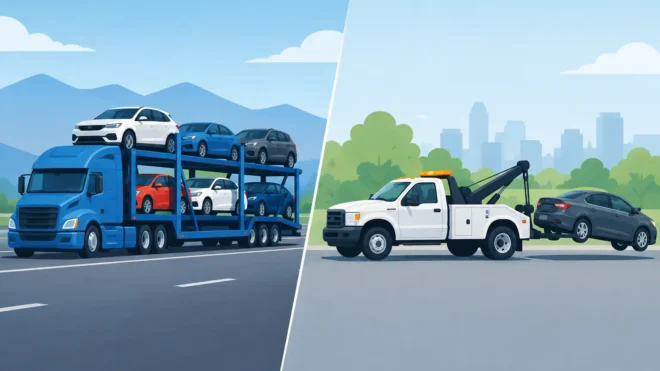
A dead battery outside your driveway and a cross-country move may both leave you asking how to move a vehicle. But vehicle transport versus towing is not a small service-level choice. The right option depends on distance, vehicle condition, timing, and whether you need recovery or planned delivery.
Towing is designed to get a disabled or improperly parked vehicle from one nearby location to another. Vehicle transport is designed to move a running vehicle safely over long distances without adding miles, fuel costs, road wear, or driving stress. Knowing the difference can save time, prevent unnecessary expense, and help you arrange the right service from the start.
Vehicle Transport Versus Towing: The Core Difference
A tow truck typically responds to an immediate local need. Your car may have broken down, been involved in a minor accident, suffered a flat tire, or become undrivable. The goal is usually to move it quickly to a repair shop, your home, or another nearby safe location. A flatbed tow truck can carry the vehicle completely off the road, while other towing methods may leave some wheels rolling on the pavement.
Vehicle transport, often called auto shipping, is a scheduled logistics service. A professional carrier picks up your car, truck, SUV, or specialty vehicle and delivers it to a destination in another city or state. The vehicle is secured on an open or enclosed trailer alongside other vehicles, unless you select a more specialized service. This is the practical choice for relocations, online vehicle purchases, seasonal travel, dealership moves, military-related moves, and long-distance deliveries.
The distinction matters because a tow is not usually intended for a 500-, 1,000-, or 2,000-mile trip. Long-distance towing can be costly, hard on the vehicle if it is not fully loaded, and less predictable than arranging a carrier built for interstate transportation.
When Towing Is the Better Choice
Towing is the right answer when the vehicle cannot be driven safely or needs immediate local assistance. If your engine will not start, a collision has made the car unsafe, or you are stranded on the side of the road, a tow company can provide the fast response you need.
It can also make sense for a short move within the same area. For example, you may need to take a non-running classic car from a storage unit to a local mechanic, move a project vehicle to a nearby shop, or relocate a vehicle with severe mechanical problems. In these situations, speed and short-distance recovery matter more than long-haul shipping coordination.
A flatbed tow is often preferable for all-wheel-drive vehicles, low-clearance cars, damaged vehicles, and cars that should not have any wheels on the road. Still, the towing company needs to know the vehicle’s condition, approximate weight, and pickup situation before dispatching the correct equipment.
Towing becomes less attractive as mileage increases. A long tow can require multiple arrangements, higher per-mile charges, overnight planning, and more exposure to road debris and weather. If the vehicle is being moved to another state, a transport carrier will generally be the more sensible option.
When Vehicle Transport Makes More Sense
Auto shipping is built for planned, long-distance moves. If you are relocating from Florida to Texas, buying a vehicle from an out-of-state seller, sending a student vehicle to campus, or moving south for the winter, shipping keeps your vehicle off the road while you focus on everything else involved in the move.
The biggest benefit is reduced wear. Driving across several states adds mileage, uses fuel, creates opportunities for tire damage, and exposes your vehicle to traffic, storms, and road debris. It also costs your time. A multi-day drive may require hotel stays, meals, time away from work, and a detailed route plan. Transport allows the vehicle to travel while you fly, drive another vehicle, or handle your relocation on your own schedule.
Open carrier shipping is a dependable, budget-conscious option for most standard vehicles. Your car is loaded onto a multi-car trailer and secured for the trip. Enclosed transport provides additional protection from weather and road exposure, making it a strong option for classic cars, luxury vehicles, exotic models, or any vehicle whose owner wants a higher level of protection.
Vehicle transport can also accommodate more than one vehicle. Families moving across the country and dealerships moving inventory often benefit from coordinating multiple pickups and deliveries through one transport provider. That is much easier than arranging separate long-distance towing services or asking several drivers to make the trip.
Cost: Look Beyond the Initial Price
A local tow can appear less expensive because it is a simple, short-distance service. For a breakdown near home, it usually is. But towing and transport should not be compared only by their opening price. They solve different problems.
For a long-distance move, calculate the full cost of driving or towing yourself: fuel, lodging, meals, tolls, tire wear, oil changes, lost work time, and the possibility of unexpected repairs. If you are towing a car behind a moving truck or another vehicle, include rental equipment, insurance considerations, fuel economy loss, and your comfort level handling the setup through traffic and mountain grades.
Auto transport pricing is affected by route, distance, vehicle size, time of year, pickup and delivery accessibility, service level, and how quickly you need the vehicle moved. A standard sedan on a major route is often easier to schedule than a large pickup headed to a remote location. Expedited transport may cost more, but it can be worthwhile when a move date, work start date, or vehicle sale requires tighter timing.
The lowest quote is not always the best value. Ask what service is being arranged, whether the carrier can safely handle your vehicle, how pickup and delivery will be coordinated, and who will be available to answer questions. Clear communication is part of a worry-free shipment.
Vehicle Condition Can Change the Decision
A running vehicle is typically straightforward to ship. It should be able to start, steer, brake, and roll so it can be loaded and unloaded safely. Non-running vehicles can often be transported too, but they require advance notice because the carrier may need equipment such as a winch and an appropriate loading plan.
Do not assume a tow is the only option just because a vehicle does not start. For a long move, a non-running vehicle can still be shipped by a carrier equipped to handle it. The key is being direct about its condition. Let the transport advisor know about mechanical issues, low ground clearance, oversized tires, modifications, inoperable brakes, or any damage that affects loading.
For towing, condition matters even more in the moment. A damaged suspension, locked wheel, or vehicle stuck in a garage may require specialized recovery equipment rather than a standard tow truck. Sharing accurate details helps prevent delays and avoids sending equipment that cannot safely complete the job.
How to Choose the Right Service
Start with one question: is this an urgent recovery or a planned move? If your vehicle is stranded, unsafe to drive, or headed to a local repair facility, call for towing. If it needs to travel hundreds or thousands of miles, plan for vehicle transport.
Next, consider timing. Towing is usually immediate or same-day. Transport requires a pickup window and delivery coordination, although expedited service may be available when time is limited. Finally, consider protection needs. An open carrier is suitable for many everyday vehicles, while enclosed shipping offers added peace of mind for high-value, collector, and premium vehicles.
Before scheduling transport, remove personal belongings, document the vehicle’s condition with dated photos, keep the fuel level low, and have a working set of keys ready. Ask whether door-to-door service is available. In many cases, the carrier can meet you close to your home, although narrow streets, low branches, or neighborhood restrictions may require a nearby larger parking area for safe loading.
A Better Way to Plan a Long-Distance Move
The best choice is not about finding a service with a similar name. It is about matching the service to the job. Towing gets you out of an immediate problem. Vehicle transport handles the logistics of getting your vehicle where it needs to be without turning your move into a long road trip.
If your vehicle is headed across state lines, AutoPlex Transport can help you select open, enclosed, door-to-door, or expedited shipping based on your route, vehicle, and schedule. A clear quote and a conversation with a transport advisor can turn a complicated move into a well-coordinated pickup and delivery.
